



























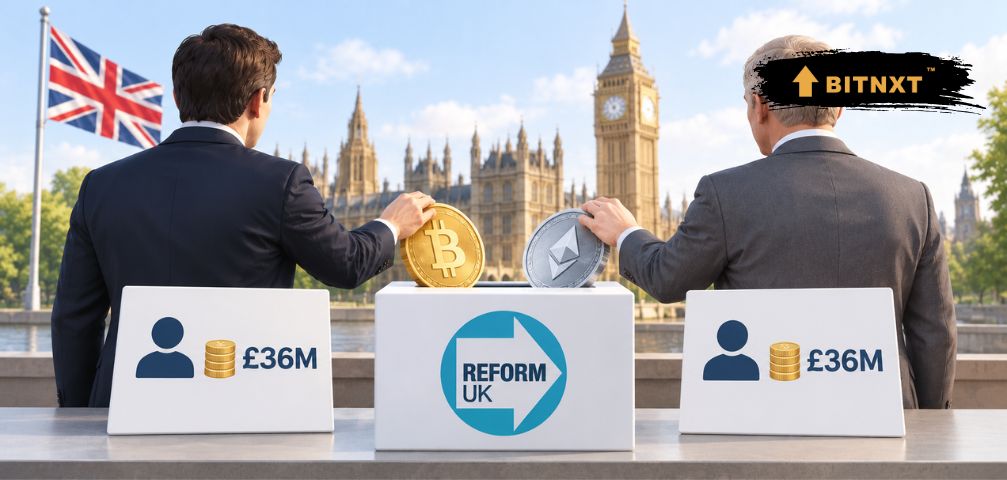
Ben Delo just gave Nigel Farage's Reform UK £36 million, and Christopher Harborne matched it with £36 million more, delivered within roughly 24 hours on September 11-12 and totaling £72 million, about $97 million, the single largest political donation in British political history. Both men built their fortunes in crypto: Delo, the BitMEX co-founder widely described as Britain's first crypto billionaire, pleaded guilty in the U.S. to Bank Secrecy Act violations tied to the exchange before receiving a presidential pardon in March 2025, and has since returned to the UK from Hong Kong. Harborne, a British and Thai dual citizen living in Thailand, is a longtime investor in Tether and Bitfinex who has bankrolled British politics before, including £3 million to Reform in Q1 2026 on top of roughly £9 million in historical cash gifts, per Electoral Commission registers.
The scale needs context to land. UK parties routinely fight general elections on annual budgets smaller than what these two men donated between breakfast and dinner. One check equals several leadership contests, and the combined £72 million arrives in a system where Delo's earlier £4 million already constituted 75% of a quarter's funding and where the donor base's Tether links have made stablecoin money in Westminster a running controversy.
What £72 Million Buys in British Politics
The honest answer: structurally more than it would in the U.S. Britain caps campaign spending per constituency, so the money's leverage is not broadcast advertising but organizational permanence, staff, field operations, data, candidate training, and the ability to fight hundreds of local council seats that national parties otherwise abandon. Reform's electoral position makes the gift pointed: after becoming the main opposition in May's Senedd election with 34 seats, the party now has the resources to professionalize at a speed its rivals did not have to respect until now. The timing is the sharper signal, because the gifts landed days before the Representation of the People Bill reaches the House of Lords with a government amendment capping overseas-elector donations at £100,000 annually, retrospectively. A donor who moves before a cap closes is making a lawful bet that rules in force at signing time govern the gift, a legal question the Lords will now decide.
The Redemption Frame and the Backlash
Both donors deploy the same defense: the money is clean, the intent is civic. Harborne says he expects "nothing" in return, no policy, no peerage. Delo's camp, through allies like Robert Jenrick, notes the donations were "entirely in line with the law" and frames his return to the UK partly as compliance with tightening rules. The skeptical column writes itself: a party now materially dependent on two crypto-linked fortunes will face every future crypto policy question, taxation, stablecoin regulation, enforcement cooperation with U.S. authorities, with an apparent conflict of interest, fair or not. Reform's answer is that Labour and the Conservatives take money from interests too, hedge funds, developers, unions, and that crypto founders are simply the new wealthy class. That argument has force. It is also exactly what critics of the retrospective cap feared: by the time the law catches up, the money has already moved.
Watch the Lords proceedings this week and whether the retrospective cap survives with its 30-day return clause. The donation is history. Whether it stays history, or becomes a refund, is now a legal question.


