





























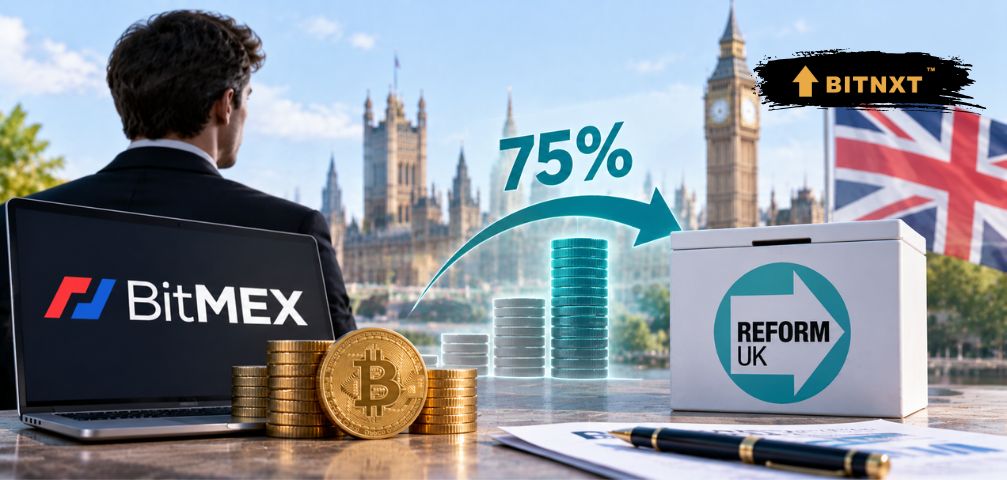
Reform UK donations reached £5.3 million in the second quarter of 2026 — and three-quarters of it came from a single crypto billionaire, as Electoral Commission records revealed that BitMEX co-founder Ben Delo supplied £4 million, making one pardoned exchange founder the dominant financial force behind Britain's fastest-growing political party.
The records, published Sept. 3, show Delo made two cash donations to Nigel Farage's party in April: £1 million and £3 million in separate transactions, together worth about $5.4 million. The quarterly total equated to roughly $7.1 million, and Reform's haul out-raised both the governing Labour Party, at about £3.6 million, and the opposition Conservatives, at £2.8 million. Delo, who co-founded the crypto derivatives exchange BitMEX, announced this year that he was returning to the UK from Hong Kong, saying he wanted to enter politics "to save Britain before decline becomes irreversible."
A Crypto Fortune Reshaping Reform UK Donations and Party Funding
The Q2 figure is the second consecutive quarter in which Reform's funding has leaned on crypto wealth. Having donated £4 million in the first quarter as well, Delo has now given the party £8 million in 2026 alone. In Q1, Reform raised £9.3 million, with Delo contributing £4 million and crypto investor Christopher Harborne providing slightly more than £3 million — a British-born investor who lives in Thailand and holds a stake in stablecoin issuer Tether. Notably, Harborne did not report a contribution in Q2, an absence that followed the UK government's plans to cap political donations from British citizens living abroad at £100,000 per year. Reuters reported that Harborne has registered to vote in the UK, but the proposed rules have placed renewed attention on how overseas donors qualify to fund domestic parties — and Delo's return to Britain could affect how the limits apply to his own future giving.
The party's crypto connections extend beyond donations. A parliamentary inquiry is examining whether Farage failed to declare a £5 million personal gift from Harborne under House of Commons rules — Farage says it was an unconditional personal gift for security costs; Parliamentary Standards Commissioner Daniel Greenberg opened an investigation; and Farage resigned as an MP in July, won the resulting Clacton by-election with 63.34% of the vote, and returned to Parliament while the inquiries remain active. He denies wrongdoing.
From BitMEX conviction to presidential pardon to party donor
Delo's path to becoming Reform's dominant donor runs directly through American crypto enforcement. The U.S. Department of Justice charged him alongside BitMEX co-founders Arthur Hayes and Samuel Reed over the exchange's failure to maintain an adequate anti-money laundering program, and Delo pleaded guilty in February 2022 to violating the Bank Secrecy Act — accepting responsibility for failing to establish and maintain the required compliance program for a platform serving U.S. customers. A federal judge sentenced him to 30 months of probation and a $10 million criminal fine. In March 2025, President Donald Trump pardoned all three co-founders. The trajectory — conviction, pardon, then £8 million into a national political party within two years — would have been unthinkable in British politics a decade ago, and it is now a matter of public record through the Electoral Commission's registers.
The crypto donation debate gains urgency
The figures land amid an unresolved British argument over political money from the digital asset industry. Labour MP Matt Western called in February for a temporary ban on crypto donations until the Electoral Commission produced statutory guidance, proposing source checks, FCA-registered platforms and restrictions on funds connected to mixers; the government introduced a moratorium on crypto political donations in March, and Labour lawmakers have since considered making it permanent. Neither Delo's nor Harborne's donations were crypto transfers — Electoral Commission filings identified Delo's April payments as cash — but the debate now covers wealthy individuals whose fortunes came from crypto regardless of the payment rail.
Farage had positioned Reform as the crypto-friendly party, announcing at the Bitcoin 2025 conference in Las Vegas that it would accept digital asset donations — a first among major Westminster parties. Ireland's exclusion of crypto from tax-advantaged accounts shows governments picking different lanes on digital assets; Britain's donor debate shows the political-financial channel is the next contested frontier. When one pardoned crypto founder funds a quarter of a major party's annual intake, the question of who finances British politics has acquired a distinctly blockchain flavor.


