
























.jpg)

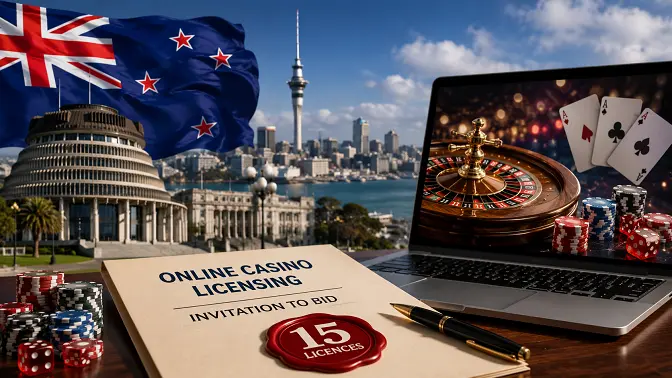
New Zealand has formally launched the first stage of its new online casino licensing regime, inviting operators to submit expressions of interest (EOIs) for one of up to 15 licences under the Online Casino Gambling Act 2026. It is the country’s first move to bring a largely offshore-controlled market under domestic regulation — a shift lawyers are calling the most significant change to New Zealand gambling law in more than two decades. Here is a research-backed breakdown of how the process works, who wants in, and what it means.
The EOI Stage and Requirements
Effective 17 July 2026, the Department of Internal Affairs (DIA) opened the EOI submission window, with companies required to file entries through the Government Electronic Tender Service (GETS) by 14 August. Each submission carries a non-refundable fee of NZ$19,000 (about US$11,100). The process is built to admit only well-capitalised, established operators: applicants must demonstrate access to at least NZ$7.5 million in capital and provide full disclosure of ownership, management structures, and the platforms they intend to run. Individuals linked to an operator must submit identification, criminal-record clearances, and proof of funds, and any prior regulatory breaches, legal investigations, or insolvency events must be disclosed.
How the Licences Work
The framework caps the market at 15 brand-specific licences, and no single operator may hold — or hold “significant influence” over — more than three. “Significant influence” is defined as a 20% ownership or voting threshold. Each licence covers a single brand and runs for up to three years, with the possibility of a single renewal of up to five more. Licensed operators are expected to offer games such as slots, blackjack, roulette, peer-to-peer poker, and computer-simulated sports events, while TAB NZ retains its monopoly over conventional sports and racing betting. Once granted, a licensee generally has 90 days to get its platform live and must keep it available for a minimum period each year.
The Three-Stage Timeline
The rollout runs in three stages, all administered through GETS. After the EOI phase closes on 14 August, the second stage is a competitive auction scheduled for September 2026, in which accepted applicants bid for the right to apply — licences are awarded on the highest bid price, and there is no requirement to issue all 15. The third stage, expected from October, invites successful bidders to submit comprehensive full applications, including business plans and detailed strategies for advertising, consumer protection, harm minimisation, and compliance. The DIA anticipates final licences being issued in early 2027, aligning with the planned market launch (some reporting has pointed to a launch as early as December 2026). A DIA spokesperson said the timeline gives regulators enough lead time to build a robust compliance framework “in a robust and considered manner, consistent with the requirements of the Act.”
The Process at a Glance
Item | Detail |
Governing law | Online Casino Gambling Act 2026 |
Regulator | Department of Internal Affairs (DIA) |
Licences available | Up to 15 (max 3 per operator); 1 brand each |
EOI deadline | 14 August 2026 (via GETS) |
EOI fee | NZ$19,000 (~US$11,100), non-refundable |
Capital requirement | Minimum NZ$7.5 million |
Auction / launch | Auction Sept 2026; licences early 2027 |
Max penalty (unlicensed) | NZ$5 million (corporate) |
From Offshore to Onshore
Before this reform, most of New Zealand’s online gambling flowed to offshore sites. DIA-commissioned research indicated that, through September 2025, New Zealand players had deposited NZ$1.36 billion with overseas operators — predominantly in hybrid casino-sportsbook formats, with only about 14% of deposits going to casino-only brands and 77% to hybrid operators. In practice, domestic licensing will largely formalise a concentration that already exists: government data show the 15 largest registered offshore entities generated an estimated 99.8% of reported gross gambling revenue, with the top five alone producing roughly 89.6%. In other words, the 15-brand cap may not dramatically reshape the competitive field so much as bring the incumbents onshore.
Taxes, Enforcement, and Harm Controls
The new regime attaches real obligations and real teeth. Licensed operators will pay local taxes including GST, gambling duty, and regulatory levies; reporting points to a gambling-duty rate on online gambling profits and a quarterly DIA levy on those profits, and the offshore gambling duty will rise from 12% to 16% starting 1 January 2027, with the additional revenue routed through the Lottery Grants Board to community causes. Unlicensed operators will face enforcement measures including geoblocking and civil penalties up to NZ$5 million for a corporate breach (and up to NZ$300,000 for an individual). Crucially, the Act imposes consumer-protection duties absent from the old offshore framework — robust age verification (all reasonable steps to confirm players are 18+, via digital identity checks rather than a tick-box), harm-minimisation controls, complaint procedures, and record-keeping. The law also applies extraterritorially, meaning a licence is required to serve New Zealand-based players regardless of where an operator is based.
Who Wants In
Interest has been broad. Entain — which operates the TAB brand in New Zealand — has signalled it wants the maximum three licences, with CEO Stella David telling analysts it intended to apply, and the group can look to cross-sell online casino games alongside sports betting. SkyCity has described domestic licensing as a strategic priority, and a range of established international operators — including bet365, 888/evoke, Super Group (Betway), SpinBet, and Spin City — have registered their interest. The controlled rollout effectively forces existing offshore operators to choose: submit to New Zealand’s oversight and taxes, or exit the market.
Why It Matters
New Zealand’s move mirrors a global trend of jurisdictions abandoning prohibition-by-default in favour of tightly controlled, licence-limited online markets that prioritise consumer protection and tax capture over speed. As True Legal director Jarrod True put it, the most significant shift is the move from an unregulated offshore market to a tightly controlled regime — and the deliberate timeline “appears intentional,” prioritising an orderly transition and robust regulatory infrastructure over a rush to market. For players, the promise is stronger safeguards; for the government, new revenue for community causes; and for operators, a scarce set of licences worth competing hard to win.
Sources and Further Reading
World Casino News – “New Zealand Begins Regulated Online Casino Licensing Process” (reference article)
iGaming Business – “New Zealand opens EOI process for licences under iGaming rollout” (DIA spokesperson; True Legal commentary)
NEXT.io – interested-operator list and market-concentration figures
Department of Internal Affairs (dia.govt.nz) – official “Online Gambling for Providers” guidance on the three-stage process
MinterEllison – legal analysis of the Online Casino Gambling Act 2026 (thresholds, duties, penalties)
Note: Details reflect reporting and official guidance from mid-2026; some specifics (e.g., the exact launch date and certain duty/levy rates) vary across sources and are attributed above, and the process remained ongoing at the time of writing. This article is for informational and educational purposes only and is not legal advice.


