
























.webp)


.jpg)

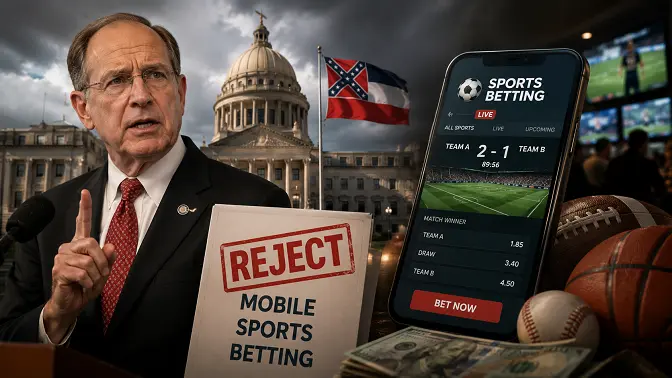
Mississippi’s long-running debate over legalizing mobile sports betting has flared up again, this time after Lieutenant Governor Delbert Hosemann publicly urged the state Senate to keep rejecting the idea. His argument leans on three concerns: gambling addiction, the threat to land-based casinos, and doubts about the economic payoff. House leaders fired back that residents are already betting on their phones illegally, framing the choice as regulate-or-enforce. Here is a research-backed breakdown of the standoff and the stakes.
What Hosemann Said
In a post on X, Hosemann warned that online mobile sports betting increases the risk of gambling-related harm and addiction compared with traditional in-person betting, and singled out young adults as especially susceptible because they can receive push notifications to bet on their phones around the clock. He went further in framing the human cost, citing that roughly one in five people with gambling disorder attempt suicide. On the economics, he argued the last House-passed bill included a 25% tax cut for casinos, said the measure would not create a single job for Mississippians, and urged: “The Senate should continue to reject this harmful legislation.”
In separate remarks, Hosemann added that mobile betting could undermine the billions of dollars invested in the state’s brick-and-mortar gaming facilities, increase opportunities for misconduct involving athletes, and leave open whether tax revenue would even cover the associated social and economic costs.
The House Pushes Back
House Ways and Means Committee Chairman Trey Lamar rejected that framing as out of step with reality. “Everybody who wants to place wagers on their mobile device does it already today,” he said, calling the opposition “tone deaf” to what is actually happening in the state. Lamar cast the decision as a binary choice: either legalize mobile sports betting and let the state’s existing casino operators help regulate the environment, or step up enforcement and go after the illegal operators profiting off Mississippians. He said he does not expect Senate opposition to derail the House’s efforts.
House Speaker Jason White has been equally direct, arguing that as a gaming state, “we have stuck our head in the sand, and we are getting left behind on this avenue of gaming revenue.” White noted that most Mississippi casino operators support mobile betting — many already run mobile sportsbooks in other states — and that the Gulf Coast delegation has voted for it repeatedly, while acknowledging lingering concern about the viability of the state’s inland “River casinos.”
The Legislative Backstory
This is not a new fight. Mississippi legalized sports betting in 2018 but confined it to wagers placed inside the geofenced confines of its roughly 30 licensed casinos. A 2024 study committee that examined statewide mobile betting reportedly received mixed feedback, with casino administrators split roughly evenly for and against. Since then, the House has passed mobile-betting bills three years running — including HB 1581, which cleared the chamber on an 85-31 vote in February 2026 — only to see them stall in the Senate. A follow-up measure, HB 4074 (sponsored, like HB 1581, by Rep. Casey Eure), tried to address Senate concerns by raising the tax on mobile sportsbooks, cutting the tax on physical casinos, and trimming license counts, but it too died when it failed to clear committee before the March 3 deadline.
The Positions at a Glance
Item | Detail |
Opponent | Lt. Gov. Delbert Hosemann (R) — urges Senate to reject |
Proponents | House Speaker Jason White, Ways & Means Chair Trey Lamar, Rep. Casey Eure |
Hosemann’s concerns | Addiction/harm, casino cannibalization, weak job/revenue case, integrity risks |
House argument | Illegal betting already widespread; legalize to regulate and capture revenue |
Current law | Sports betting allowed only inside ~30 geofenced casinos (since 2018) |
Recent bills | HB 1581 (passed House 85-31, Feb 2026); HB 4074 — both died in Senate committee |
Disputed provision | 25% tax cut for casinos; a $6M pool for casinos in one House version |
Next round | Expected when the legislature reconvenes in January 2027 |
The Casino-Protection Sticking Point
A core tension is how to legalize mobile betting without cannibalizing the brick-and-mortar casinos that anchor the state’s gaming economy. The House’s approach has been to require mobile operators such as DraftKings, FanDuel, and BetMGM to partner with in-state casinos so both sides share the upside, leveraging the sportsbook infrastructure casinos already run. One House version reportedly went further, setting aside a roughly $6 million pool to compensate casinos. Hosemann’s counter is that the accompanying 25% casino tax cut and uncertain revenue undercut the fiscal rationale — a disagreement as much about who benefits as about whether to legalize at all.
What the Research Shows
The debate is informed by real data on college-age bettors. Research led by Dr. George McClellan, a professor of higher education at the University of Mississippi who studies gambling, found that in a survey of four-year college students in the state, about 40% reported gambling in the past year, and more than half of those who bet on sports said they did so online. McClellan noted that online betting is associated with higher rates of addictive gambling behavior, while stressing that his team does not advocate a particular legislative outcome. His pragmatic conclusion — “the thing I know we can’t do is we can’t stop it” — and his call to invest in better data collection and support networks capture the bind lawmakers face.
Why It Matters
Mississippi is one of a shrinking number of states that permit in-person sports betting but not statewide mobile wagering, and its standoff mirrors a national tension between tax-revenue opportunity and problem-gambling concern. The immediate practical reality is that with both 2026 bills dead, the status quo holds until at least the 2027 session — meaning the illegal-market activity that both sides acknowledge continues largely unaddressed. However the politics resolve, the episode underscores that responsible-gambling safeguards, especially for young and vulnerable bettors, are now central to any credible expansion debate.
Responsible gambling note: If you or someone you know is struggling with gambling, confidential help is available in the U.S. through the National Problem Gambling Helpline at 1-800-GAMBLER.
Sources and Further Reading
Yogonet International – “Mississippi Lieutenant Governor urges Senate to reject mobile sports betting” (reference article)
Magnolia Tribune / Mississippi Monitor – Hosemann’s remarks and Speaker Jason White’s response
SuperTalk Mississippi – background on the 2024 study committee, geofenced casinos, and the $6M casino pool
Gambling Insider – legislative history of HB 1581, HB 4074, and SB 2104 in the 2026 session
Sports Betting Dime / WLBT – additional coverage of the House–Senate divide and Rep. Casey Eure’s bills
Note: Details reflect reporting from July 2026 and the 2026 Mississippi legislative session. This article is for informational and educational purposes only and is not legal or gambling advice.


