
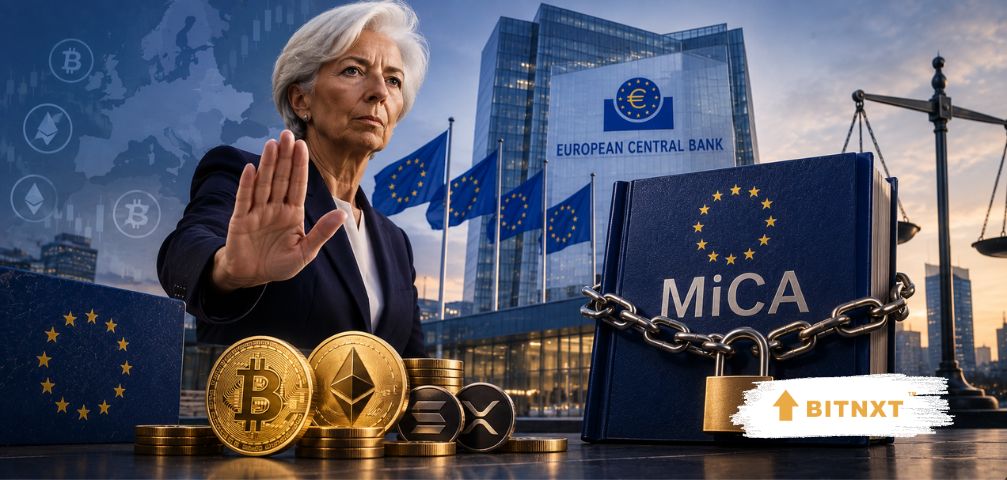
The European Commission’s targeted consultation on reviewing MiCA stablecoin rules closed on 31 August 2026. It will feed into reports the Commission is required to produce, and it has been widely read as the opening of a MiCA 2.0 process.
Plenty of the industry’s asks are winnable. Proportionality for smaller firms, clarity on NFTs, a workable position on DeFi, smoother supervisory practice across member states — none of these threaten anything the European Central Bank cares deeply about.
One does. And on that one, the ECB has already spent eighteen months making its position unmistakable.
What “loosening” actually means here
Strip away the general complaints about compliance cost and the substantive liberalisation the global stablecoin industry wants from a MiCA review is specific: permission for third-country multi-issuance.
MULTI-ISSUANCE, EXPLAINED
The same stablecoin is issued by two entities — one inside the EU, one outside — and the tokens are treated as fully fungible regardless of which entity minted them.
Reserves backing the coin are split across jurisdictions and managed under different regulatory regimes.
MiCA regulates intra-Union multi-issuance. It does not explicitly address schemes involving a Union issuer and a third-country issuer — which is precisely the gap being fought over.
That silence has produced exactly what you would expect. Some national competent authorities have taken the view that third-country multi-issuer schemes are permitted under MiCA. Others have concluded they are not. Meanwhile issuers market the tokens as fully fungible regardless of jurisdiction of origin.
The ECB’s objection, in mechanics rather than rhetoric
It would be easy to dismiss the ECB’s position as reflexive protectionism. The technical argument deserves better than that, because it is coherent.
The scheme works like this. An EU issuer may face redemption requests not only from EU holders but from holders of tokens originally issued abroad, because the tokens are interchangeable. If EU-based reserves are insufficient to meet those claims, the arrangement depends on the third-country entity transferring assets into the EU reserve pool.
The ECB’s objections follow from that dependency:
Reserves are fragmented. Assets are split and managed under different regimes, with no guarantee that reserves held abroad will be available for EU redemptions during a stress episode.
Transfers may not arrive. Foreign supervisors could restrict or ring-fence assets precisely when they are needed. Where reserves sit in third-country money market funds, redemption can be frozen locally.
The redemption promises differ. EU law requires prompt, cost-free redemption at par by EU issuers. A third-country issuer may apply fees or delays.
EU reserves could subsidise non-EU claims. Assets designed to protect European holders might end up covering claims from investors outside the Union.
An accountability gap opens. EU supervisors would become de facto responsible for the liabilities of third-country issuers over which they have no legal or operational control.
Strip out the sovereignty language and the ECB’s core complaint is simple: an EU entity would be liable for redemptions it cannot fund and cannot control.
The legal argument
The ECB set out its reading in a non-paper on EU and third-country stablecoin multi-issuance dated 10 April 2026, arguing for an interpretation of MiCA that would not permit third-country multi-issuance. The European Systemic Risk Board had reached a similar conclusion in a recommendation the previous September.
Two strands to the legal case. First, that legislators deliberately set differing requirements for different types of stablecoin within MiCA, and reading in a permission that was never granted disregards that design. Second, and more technically, that recitals cannot create new legal rights or obligations under EU law — which matters because much of the permissive reading leans on recital language rather than operative articles.
There is also a structural gap the ECB keeps pointing at. Third-country multi-issuance implicitly assumes the regimes involved are equivalent, but MiCA contains no provisions for conducting an equivalence assessment. Article 140(2) instead requires the Commission, in consultation with the EBA and ESMA, to report to legislators by June 2027 on whether an equivalence regime is needed at all.
The ECB’s conclusion from that timeline is straightforward: it is premature for the EU to settle on a definitive approach to multi-issuance, particularly one that appears to favour the interests of third countries over those of the Union.
The institutional split
Institution | Position |
European Central Bank | Multi-issuance should not be read as permitted under MiCA. Warns of shortfall risk, monetary sovereignty and supervisory ambiguity. |
European Systemic Risk Board | Reached a similar conclusion, flagging financial stability concerns and arguing such schemes should not be admissible or should face stricter supervision. |
Key members of the European Parliament | Have backed the ECB’s view and argued this is a political question deserving a political debate. |
European Commission | Has not appeared to share the severity of those concerns and has sought to resolve the question through internal administrative procedures. |
National competent authorities | Divided. Some treat third-country multi-issuance as permitted; others do not. |
The part that is not really about crypto
Here is why this fight is harder than a technical disagreement about reserve fragmentation would suggest.
A permissive interpretation would offer significant advantages to third-country stablecoin issuers relative to potential EU issuers, because MiCA imposes requirements that third-country frameworks generally do not replicate. The competitive tilt runs against domestic issuers, not towards them.
And the reserves of third-country issuers would likely be invested outside the Union in dollar-denominated assets — a point made explicitly in the material circulated to the Council, and one that cuts directly against the EU’s Savings and Investment Union agenda. Euro savings backing dollar-denominated reserves held abroad is, from a European policymaker’s desk, capital flight with extra steps.
MiCA also already contains a lever aimed at this: reporting thresholds and a statutory cap on large-scale issuance of stablecoins denominated in non-EU currencies, with competent authorities empowered to impose caps. That mechanism exists specifically to prevent dollar stablecoins scaling into euro-area payments. Allowing multi-issuance would create an obvious route around it.
So the ECB is not defending a technical rule. It is defending a policy choice about whose currency circulates in European payments.
The digital euro clock
The final reason the ECB will not loosen is that it is building an alternative, and the alternative is years away.
Milestone | Timing |
Wholesale settlement of DLT-based transactions in tokenized central bank money | From September 2026 |
EU legislation on the digital euro adopted | Assumed during 2026 — the Parliament has been the main obstacle |
Pilot with 36 selected payment providers, across the ECB and 19 national central banks | 12 months from the second half of 2027 |
Potential first issuance | During 2029, subject to legislation |
The ECB selected those 36 providers on 14 July 2026 from more than 50 applicants. A draft rulebook, version 0.91, was published in July. Executive Board member Piero Cipollone has framed the project as public payments infrastructure that private intermediaries would build on, designed with holding limits to protect commercial bank deposits, and argued it would preserve the role of public money while keeping banks in the payments ecosystem.
He has also been direct that wider stablecoin use could erode banks’ retail deposits — the same concern that stalled market structure legislation in the United States, arriving at a different institutional answer.
Put the two timelines side by side and the incentive is obvious. A euro-denominated public alternative does not exist before 2029 at the earliest. Loosening the constraints on dollar stablecoins in 2026 or 2027 would let them entrench in European payments during exactly the window when there is nothing to compete with them. Distribution advantages in payments compound; they do not politely wait for a central bank to finish building.
The case for loosening, fairly stated
This is a genuinely contested policy question and the industry’s objections are not frivolous.
The industry’s case | The ECB and ESRB response |
MiCA has already cost Europe a large share of its crypto market, with roughly 1,700 platforms halting EU services after the transition ended. | A smaller licensed market with real consumer protection was the intended outcome, not an accident. |
Compliance costs are heavy for smaller firms, and Europe risks ceding ground to jurisdictions with lighter regimes. | Proportionality can be addressed in the review without touching multi-issuance, which is a distinct question. |
Blocking multi-issuance fragments global liquidity and makes EU-issued tokens less useful. | Fungibility is precisely the mechanism that transmits third-country risk into EU reserves. |
Users will access dollar stablecoins regardless; formalising the arrangement improves oversight. | Formalising it would make EU supervisors accountable for liabilities they cannot control. |
What to watch
The Commission’s response to the consultation, and specifically whether multi-issuance is treated as a legal-interpretation question to be handled administratively or as a legislative question for the co-legislators.
The June 2027 equivalence report required under Article 140(2). If an equivalence regime is recommended, that becomes the route through which controlled third-country access arrives — with conditions attached.
Whether national competent authorities continue to diverge. Sustained divergence on a single-market rulebook is itself an argument for legislative clarification.
Digital euro legislation. If it slips beyond 2026, the 2029 issuance date slips too, and the ECB’s window of exposure lengthens rather than closes.
Euro-denominated stablecoin supply. If domestic issuance scales meaningfully, the sovereignty argument weakens on its own terms.
The bottom line
The industry reads MiCA as crypto regulation and asks, reasonably, for it to be made more workable. The ECB reads the stablecoin provisions of MiCA as monetary policy — rules about which currency circulates in European payments and whose reserves back it.
Those two framings do not meet. That is why expectations of substantive liberalisation on multi-issuance should stay low, whatever else the review delivers.
Expect movement on proportionality, on DeFi, on supervisory consistency and on the practical friction the first year of full enforcement exposed. Do not expect the door to third-country multi-issuance to open before the equivalence report in mid-2027 — and probably not before there is a euro-denominated public alternative to point at.
Important: This article describes contested policy positions held by different EU institutions and sets out the arguments on both sides. It is analysis, not advocacy, and it is not legal, regulatory or investment advice. Positions and timelines described may change; readers should consult primary sources and qualified advisers.
Sources
ECB non-paper on EU and third-country stablecoin multi-issuance, ESRB recommendation, European Commission MiCA review consultation materials, ECB digital euro publications and speeches by Piero Cipollone, plus analysis from CEPS, CEPR, Reed Smith, Taylor Wessing and Notabene.
Bitnxt tracks stablecoin issuers, licensed exchanges and payment providers across the EU, UK, UAE and US. Explore the directory at bitnxt.io.
