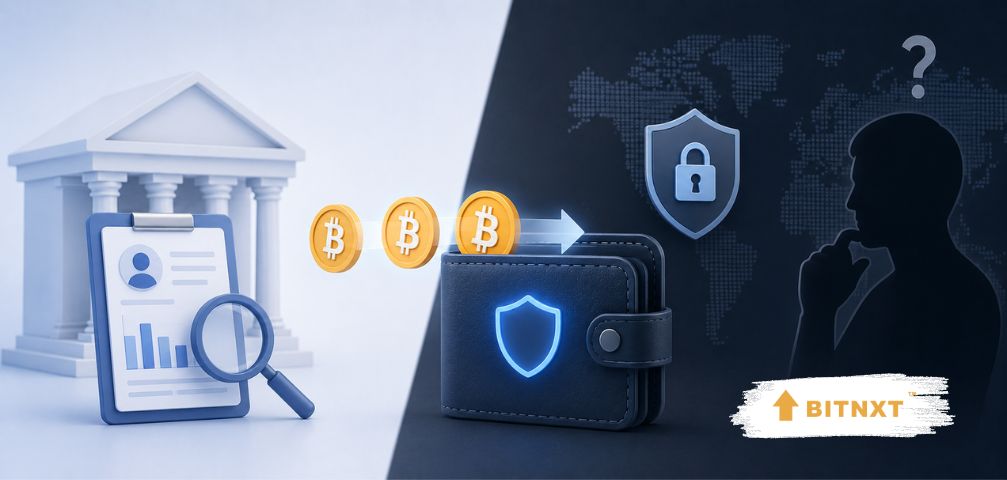
No. Moving crypto to a wallet you control is not a taxable event, and self-custody is entirely legal. But neither of those facts removes a tax liability, because the liability was never attached to where the coins were sitting.
This is worth answering carefully rather than dismissively, because the question contains a real and understandable confusion. Two true statements sit next to each other and appear to combine into a third statement that is false.
The confusion at the heart of the question
Statement one: transferring crypto between wallets you own is not taxable. True. Beneficial ownership does not change, so there is no transfer in the tax sense and nothing to charge.
Statement two: a private wallet is not operated by an exchange and does not report to anyone. Also true. A self-custody wallet has no KYC and files no returns.
The false conclusion is that moving assets into one therefore places them outside the tax net. It does not, because tax liability under Section 115BBH attaches to events, not to locations. The taxable moment is the disposal — the sale, the swap, the payment. Where the asset lives before or after that moment is irrelevant to whether the event happened.
An analogy: moving cash from your bank account into a safe at home does not undo the income that earned it. The tax arose when you earned it. The safe changes nothing except your ability to prove where it came from later.
The same applies to income-side receipts. Staking rewards, mining rewards and airdrops are taxable at fair market value on the date of receipt, at your slab rate. That charge crystallises when the tokens land, wherever they land.
Self-custody is legitimate — and worth saying clearly
Nothing in Indian tax law discourages holding your own keys. Self-custody is the correct security practice for anyone holding meaningful value, and Schedule VDA even contains a field for the self-custody wallet address used in a transaction, which tells you the department expects and accommodates it.
The problem is never the wallet. The problem is only ever an undisclosed disposal. Someone who holds in cold storage for a decade and reports properly on the day they sell has done everything right.
Where the paper trail actually is
The practical answer to "will anyone know" is that the record almost certainly already exists, and it exists upstream of the wallet.
Source | What it captures |
|---|---|
Your INR on-ramp | You bought with rupees through a KYC-verified exchange linked to your PAN and bank account. That record is permanent and predates any wallet you moved to. |
TDS records | Since 1 July 2022, 1% TDS under Section 194S has been deducted on transfers and filed against your PAN. Each deduction is a dated report to the department that you transacted. |
Statement of Financial Transactions | Exchanges and banks report transaction data to the department through the SFT mechanism, independently of anything you file. |
Form 26AS and AIS | TDS and reported transactions surface against your PAN in your own annual statement. If you can see it, so can the assessing officer. |
Bank records | Large or frequent crypto-linked deposits and withdrawals are a standard scrutiny trigger. |
Blockchain analytics | Public chains are permanently auditable. Once one address is linked to your identity through a KYC withdrawal, the addresses it interacts with become traceable. |
Section 285BAA reporting | A dedicated obligation on prescribed reporting entities to furnish crypto asset transaction information to the department. |
CARF exchange of information | India is among the jurisdictions adopting the OECD Crypto-Asset Reporting Framework, which provides for automatic cross-border exchange of crypto tax information. |
The critical point is the first row. Unless you acquired your crypto entirely outside the banking system, your entry into the asset is documented against your PAN. A wallet transfer downstream of that does not erase the upstream record — it just means the department can see that assets left and cannot see where they went. That is a worse position to be in, not a better one.
What changed recently
The enforcement architecture around this has tightened substantially, and the changes are not cosmetic.
VDAs are now inside block assessment
Virtual digital assets have been brought within the definition of undisclosed income for the purposes of block assessment in search cases under Section 158B. Where undisclosed income is determined under that route, the rate applicable is materially higher than the ordinary 30%.
Section 285BAA
A new obligation requires prescribed reporting entities to furnish information on crypto asset transactions to the department. This was introduced explicitly in connection with India's adoption of the OECD Crypto-Asset Reporting Framework.
CARF and cross-border data
CARF provides for automatic exchange of crypto tax information between participating jurisdictions, and India is among those adopting it. The practical effect is that holding on an offshore exchange stops being an information gap. Data arrives at the Indian department without anyone having to request it.
The department is already acting on this
In 2025 the Income Tax Department contacted thousands of taxpayers whose crypto activity did not match their filings, seeking transaction details. Detection relies on SFT reporting from exchanges and banks, TDS records filed since July 2022, mandatory PAN and Aadhaar KYC, and data analytics run across those sources to surface discrepancies.
What non-disclosure actually costs
The consequences are disproportionate to the amounts most retail holders are dealing with, which is precisely why this is not a sensible risk to take.
Tax on the omitted income, plus interest for the delay.
Penalties that can run from 50% of the tax for underreporting to 200% for deliberate misreporting.
Substantially higher rates where undisclosed income is determined through block assessment.
For undisclosed foreign assets, tax plus a penalty of up to three times the tax under the Black Money Act, alongside the flat ₹10 lakh penalty for a missing Schedule FA disclosure.
Prosecution provisions carrying imprisonment, with terms extending to seven years.
Set against a 30% liability, the arithmetic does not favour concealment even before considering that concealment is a criminal matter rather than a financial one.
What you can legitimately do instead
There is no structure that makes a disposal untaxable. There are four things that genuinely reduce what you pay, all of them boring and all of them effective.
Document your cost of acquisition properly
Cost of acquisition is the only deduction Section 115BBH permits, which makes it the only lever available. Every rupee you cannot substantiate is taxed at 30%. Reconstruct records across every exchange and wallet you have used, including platforms that have since closed.
Claim every rupee of TDS
TDS is a credit, not an extra tax, and it is deducted on loss-making trades as well as profitable ones. Reconcile Form 26AS and the AIS against your own records before filing. Unclaimed credits are simply forfeited.
Recognise that trading frequency is the real cost driver
Because losses cannot be set off against gains and cannot be carried forward, every realised gain is taxed in full regardless of what else happened in your portfolio. Two investors with identical returns can face very different bills based purely on how often they transacted. The regime taxes activity, not wealth.
Get the Schedule FA position right
If you hold on a foreign exchange, disclose it. There is no minimum value threshold, the penalty applies whether or not tax was due, and this is the single most expensive avoidable error in Indian crypto compliance.
If you already have unreported crypto income
This is the question behind the question for a lot of people, and there are legitimate routes back.
File a revised return if the deadline for the relevant assessment year has not passed.
File an updated return under Section 139(8A) where the revision window has closed. This route involves additional tax but is far cheaper than being found.
Make a voluntary disclosure before the department issues a notice. The distinction between coming forward and being caught is significant in how penalties are applied.
All three are materially better outcomes than waiting. Take professional advice before filing any of them, because the interaction between Schedule VDA, Schedule FA and the Black Money Act is not something to work out alone.
Frequently asked questions
Is using a hardware wallet or cold storage legal in India?
Yes. Self-custody is legal and is good security practice. Holding is not a taxable event and requires no disclosure, unless the holding qualifies as a foreign asset requiring Schedule FA reporting.
What if I never sell? Can they tax me?
Holding alone is not taxable. There is no wealth tax or unrealised gains tax on VDAs. But receipts such as staking rewards and airdrops are taxable when received, and a foreign holding is disclosable even with no tax due.
Does using a decentralised exchange change anything?
Not legally. A swap on a decentralised exchange is a transfer of a VDA and is taxable at 30% exactly as it would be on a centralised platform. What changes is only that no one deducts TDS on your behalf, which shifts the compliance burden onto you rather than removing it.
Does using a privacy coin or a mixer help?
It does not change the tax treatment. It substantially worsens your evidential position, and depending on the facts may create exposure under laws well outside the Income Tax Act. This is not a tax planning technique.
What if I bought crypto before the 2022 rules came in?
The rules apply to transfers from 1 April 2022 onward. Pre-2022 acquisitions still need a documented cost of acquisition, which is exactly why old purchase records matter so much.
The bottom line
A private wallet is a custody choice, not a tax structure. It changes where your assets sit and nothing about whether a taxable event occurred.
The trail sits upstream at the rupee on-ramp, in TDS filings against your PAN, and increasingly in automatic cross-border data exchange. The realistic path to paying less is documenting cost of acquisition, claiming TDS credits, transacting less often, and disclosing foreign holdings — not attempting to disappear from a system that already has your PAN.
This article is general information, not tax advice, and does not encourage or describe any means of avoiding lawful tax obligations. Consult a qualified chartered accountant for your own position, particularly if you have unreported income from earlier years.
Cryptoo.tax helps Indian crypto holders reconstruct cost basis across exchanges and self-custody wallets, reconcile TDS against Form 26AS and the AIS, and generate Schedule VDA-ready reports.