Dubai has become one of the few global cities where you can turn digital wealth into physical property with a clear, regulated process behind it. Whether you hold Bitcoin, Ethereum, or stablecoins like USDT, converting crypto into Dubai real estate is not only possible in 2026 — it is increasingly common, with major developers and licensed payment partners handling these transactions every day.
But it is not as simple as sending coins to a developer’s wallet and collecting the keys. To avoid scams, unnecessary conversion costs, and delays, you need to understand how the process actually works: how crypto is converted, who is legally allowed to handle it, and what the Dubai Land Department (DLD) requires to register your ownership. This step-by-step guide walks through the entire process — the accepted assets, off-plan versus ready property, how crypto is settled into your purchase, the fees involved, Golden Visa eligibility, and how to avoid the mistakes that cost buyers money.
How Crypto Property Purchases Actually Work in Dubai
Before the steps, one point clears up most of the confusion: in Dubai, crypto is the source of funds, but the property deal itself is registered and settled in UAE dirhams (AED).
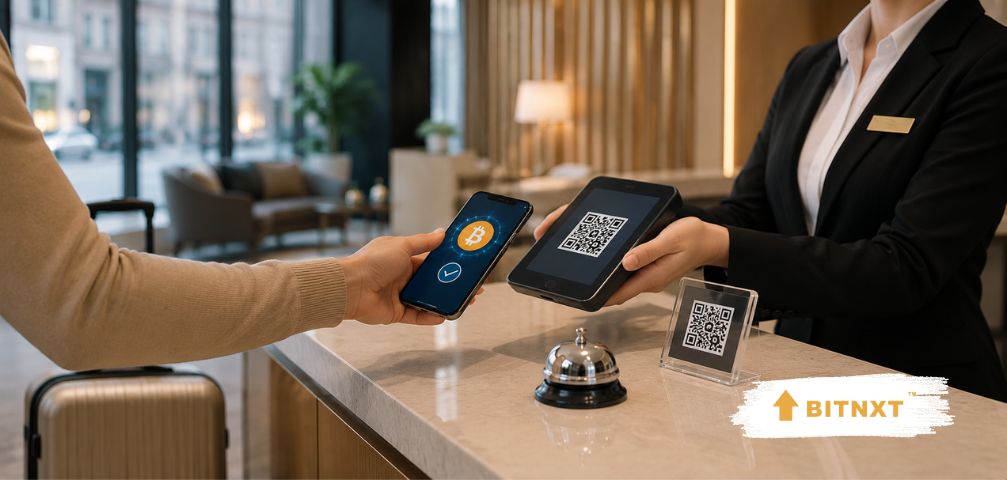
Even when a developer advertises that it “accepts crypto,” the payment almost always flows through a licensed virtual asset service provider (VASP) or OTC desk that converts your crypto to AED before it reaches the seller. The DLD registers every title deed in dirhams, and under UAE law the dirham is the settlement currency — virtual assets are not treated as legal tender. Your ownership rights are identical to those of a cash buyer; only the funding rail is different.
This matters because it tells you where compliance happens: at the conversion point. Get that step right — licensed provider, full KYC, documented source of funds — and the rest of the transaction is standard Dubai real estate.
Step 1: Know Which Cryptocurrencies Are Accepted
Not every token moves smoothly through Dubai’s property ecosystem. Developers and licensed payment partners generally work with a short list of major assets:
USDT (Tether), especially on the TRC20 network — favoured for low fees and fast settlement.
USDC, a growing stablecoin alternative.
Bitcoin (BTC), widely accepted by developers and OTC desks.
Ethereum (ETH), accepted, though its price can move during the transfer window.
USDT is the preferred choice for most transactions. Because it is pegged to the US dollar, it removes the price risk between the moment you send funds and the moment they are converted — which matters a great deal on a seven-figure purchase. If you hold altcoins or lesser-known tokens, convert them to USDT or another accepted asset on a reputable exchange first, and always confirm with your provider in advance which assets and networks they support. Sending crypto on the wrong network can be irreversible.
Step 2: Choose Between Off-Plan and Ready Property
Both routes work with crypto, but the process differs.
Off-Plan Property (the simpler route)
Buying off-plan directly from a developer is the cleanest way to use crypto. Several major developers — including DAMAC, Binghatti, Emaar, and Ellington — now support crypto-funded purchases through approved payment partners. The typical flow:
Choose the off-plan project and unit.
Complete KYC and AML documentation with the developer or its payment partner.
Receive approval for crypto-funded payment.
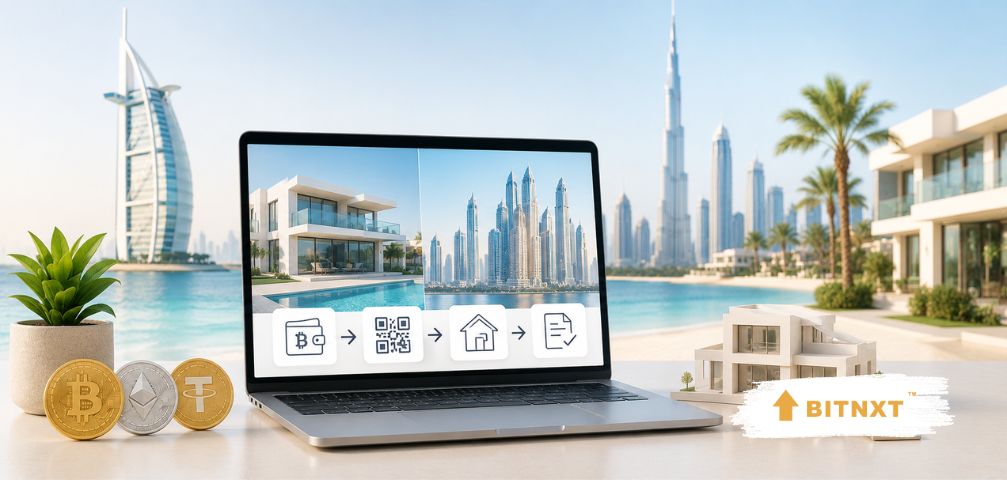
Send your crypto to the licensed provider’s wallet (not the developer’s).
The provider converts crypto to AED and forwards dirhams to the developer.
The developer issues your Sale and Purchase Agreement (SPA) and registers the unit with the DLD.
Off-plan purchases also offer flexible payment plans (often 40/60, 60/40, or post-handover plans), which can be funded in crypto tranches as the build progresses. This spreads your conversion over time and can reduce the impact of any single day’s exchange rate.
Ready Property (slightly more involved)
Buying a completed, ready property with crypto is possible but usually involves a secondary-market seller, a real estate agent, and a licensed payment partner or escrow service. The flow is similar, but the conversion and transfer must be coordinated with the DLD’s transfer appointment, and the seller’s bank must accept the incoming dirham transfer. Ready property is the better choice if you want immediate rental income or to live in the unit right away; off-plan is the better choice if you want a lower entry price, a payment plan, and a longer settlement window.
Step 3: Avoid the Scams
Crypto real estate is a magnet for fraud because the sums are large and the process is unfamiliar to most buyers. Protect yourself with these checks:
Use only licensed providers. The conversion must go through a VASP or OTC desk licensed by VARA (Dubai’s crypto regulator) or another recognised UAE authority. Ask for the licence number and verify it.
Never send crypto directly to a developer or seller’s wallet. Legitimate deals route funds through a licensed intermediary that converts to AED. A developer that asks you to send BTC or USDT straight to its wallet is a red flag.
Get everything in writing. Before you send a single satoshi, you should have a signed SPA or Memorandum of Understanding (MOU), a written crypto payment approval, the provider’s wallet address, and the agreed conversion rate or margin.
Verify the property and the seller. For ready property, request the title deed and confirm ownership with the DLD. For off-plan, confirm the developer is registered and the project is DLD-approved (check the project’s escrow account).
Use an escrow where possible. Some licensed payment partners and law firms offer escrow services that hold the converted dirhams until the DLD transfer is complete, protecting both sides.
Step 4: Understand the Fees
Crypto-funded purchases carry the standard Dubai property costs plus a conversion layer. Budget for the following:
DLD transfer fee — 4% of the property value, plus a fixed administrative fee (typically AED 580 for off-plan, AED 4,000+ for ready). This is the largest single cost and is the same whether you pay in crypto or cash.
Crypto-to-AED conversion fee — 1.5% to 3% charged by the licensed payment partner. This covers the spread and the OTC desk’s service. Stablecoin conversions sit at the lower end; volatile assets like BTC and ETH may sit higher.
Agent commission — 2% of the property value (for ready property and secondary-market deals). Off-plan bought directly from a developer usually carries no agent commission.
Trustee / escrow fee — AED 4,000–5,000 for off-plan, paid to the DLD-licensed trustee who manages the project’s escrow account.
NO Objection Certificate (NOC) fee — AED 500–5,000 for ready property, paid to the developer for clearance before transfer.
Network / blockchain fees — small for TRC20 USDT, larger for BTC or ETH during congested periods. Confirm the network your provider uses.
As a rule of thumb, expect total transaction costs of roughly 6% to 8% of the property value on top of the purchase price, with the conversion fee being the only piece unique to crypto-funded deals.
Step 5: Golden Visa Eligibility Through Property
One of the biggest reasons international buyers use crypto to buy Dubai property is the 10-year Golden Visa. As of 2026, property valued at AED 2 million or more qualifies for the 10-year Golden Visa for the owner, their spouse, and children. Since February 2026, the down-payment barrier that previously required a minimum AED 1 million in paid equity has been removed — the full property value now counts toward eligibility, even on a financed or off-plan purchase with a payment plan.
Key points about the Golden Visa route:
Eligible property types — residential property (apartment, villa, townhouse) held in your name. Commercial property does not qualify for the real-estate Golden Visa.
Off-plan qualifies — as long as the SPA is registered with the DLD and the property value meets the threshold.
Financed purchases qualify — a mortgage-backed purchase counts toward the threshold, provided the property’s total value is at least AED 2 million.
Visa scope — the 10-year visa covers the primary holder, spouse, and unmarried children of any age, with no sponsor salary requirement.
Documentation — you will need the title deed (or SPA for off-plan), proof of funds originating outside the UAE (your crypto exchange statements and conversion receipts serve this purpose), and a standard medical and biometrics appointment.
Because the Golden Visa is one of the most valuable outcomes of a Dubai property purchase, confirm your target property’s value and structure before you commit to a crypto conversion — buying just below the AED 2 million threshold to save on price can cost you the visa you actually wanted.
Step 6: Rent Out Your Property (Optional)
Many crypto buyers purchase Dubai property as an income-generating investment rather than a home. Dubai’s rental market in 2026 offers gross yields of roughly 6% to 10%, with off-plan and emerging-area properties at the higher end and established prime areas at the lower end. If you plan to rent:
Use a RERA-registered agent to manage the lease. RERA (the Real Estate Regulatory Agency) governs leasing and requires all rental contracts to be registered via the Ejari system.
Understand the rental cycle — Dubai leases typically run for one year, with rent paid in 1, 2, 4, or 6 cheques. As an overseas landlord, fewer cheques mean less administrative friction.
Rental income is not taxed in Dubai — the UAE has no personal income tax, so rental income is received gross. (Your home country may still tax you on worldwide income — check with a tax advisor.)
Service charges apply — building maintenance and service charges are deducted from rental income and vary by building and location.
A Real Example: From USDT to a Waterfront Apartment
To make the process concrete, here is how a typical crypto-funded purchase plays out end to end:
Selection — A buyer chooses an off-plan 1-bedroom apartment in a Binghatti waterfront project, priced at AED 1.2 million, with a 60/40 payment plan.
KYC — The buyer completes KYC with the developer’s licensed payment partner, submitting passport, proof of address, and exchange statements showing the source of the USDT.
Approval — The developer issues written crypto payment approval, the payment partner provides its TRC20 wallet address, and the conversion margin (1.8%) is confirmed in writing.
Conversion — The buyer sends USDT to the payment partner’s wallet. The partner converts to AED at the agreed rate and forwards dirhams to the developer’s escrow account.
SPA and DLD registration — The developer issues the SPA, the DLD registers the unit, and the 4% transfer fee is paid in AED. The buyer receives a registered title confirmation.
Golden Visa — Because the property is below the AED 2 million threshold, the buyer later tops up with a second unit or upgrades to qualify for the 10-year Golden Visa, using the same crypto-funded process.
From the first USDT transfer to a registered SPA, the process typically takes 3 to 10 business days, depending on KYC speed, blockchain confirmation times, and the developer’s registration queue.
Where Dubai Is Heading: Tokenized Real Estate
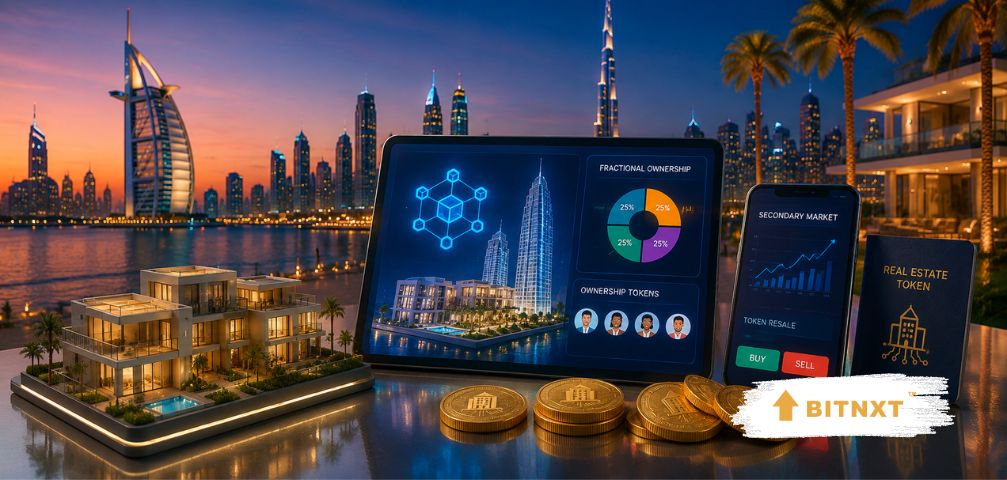
Looking beyond 2026, Dubai is actively building a tokenized real estate ecosystem. The DLD and VARA are working on frameworks that would allow fractional ownership of property through security tokens, letting investors buy a share of a Dubai asset for a fraction of the full price. Early pilots have already tokenized select properties, and the direction of travel is toward a market where crypto and traditional property ownership converge more tightly.
For buyers today, this means two things: first, the regulatory environment is becoming more, not less, crypto-friendly over time; second, the compliance bar is rising, so buying through licensed, well-documented channels now builds the track record you will need as the market matures.
Practical Tips Before You Start
Convert to USDT before you need it. Holding the AED-equivalent in USDT in advance removes last-minute price risk and lets you move quickly when you find the right property.
Get your KYC documents ready early. Passport, proof of address, and 3–6 months of exchange statements showing the source of your crypto speed up the process dramatically.
Work with a licensed payment partner, not a peer-to-peer seller. The small fee a licensed VASP charges is the price of a clean, registered, fraud-resistant transaction.
Plan the Golden Visa from the start. If residency is your goal, target AED 2 million+ from the outset rather than trying to top up later.
Keep every receipt. Conversion records, transfer confirmations, and the SPA are your evidence of source of funds — essential for the visa application and for any future sale or repatriation of funds.
Use a crypto tax tool to track cost basis. Converting crypto to AED is a taxable event in many home jurisdictions; keep clean records for your local tax authority.
Is Dubai the Best Place to Turn Crypto Into Property?
For investors who want to convert digital wealth into a tangible, income-producing, residency-qualifying asset, Dubai is one of the strongest options in the world in 2026. The combination of a regulated conversion process, no personal income tax, high rental yields, a clear path to a 10-year Golden Visa, and a growing tokenized real estate ecosystem makes it genuinely competitive against other crypto-friendly markets like Portugal, Turkey, and El Salvador.
The key is to treat crypto as the source of funds — not as a shortcut around compliance. Use licensed providers, document your source of funds, understand the fees, and structure the purchase around your real goal (residency, rental income, or capital appreciation). Do that, and turning Bitcoin, Ethereum, or USDT into a Dubai apartment is a well-trodden path rather than an experiment — one that ends with a registered title deed in your name and, if you plan it right, a 10-year visa to go with it.