


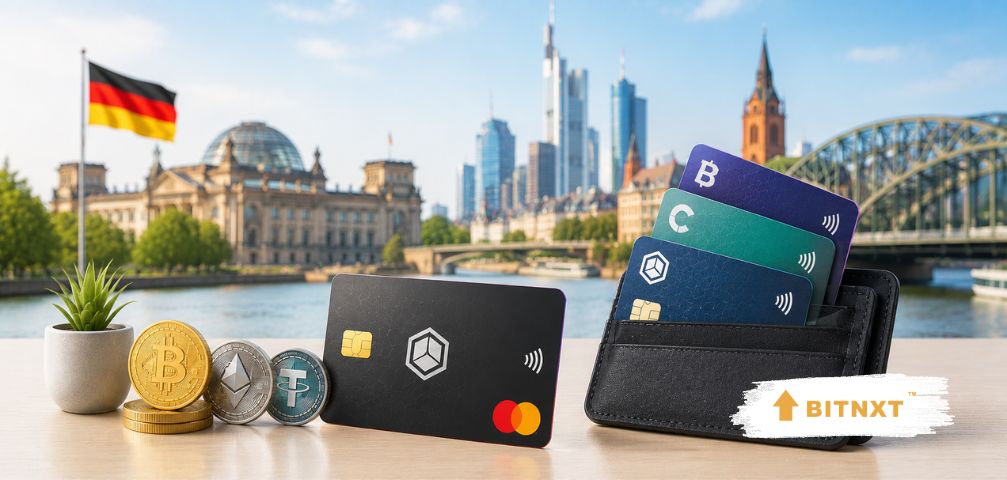
Crypto cards have moved from a niche perk to a mainstream spending tool, and German residents in 2026 have a genuinely competitive market to choose from. A crypto debit or prepaid card lets you spend Bitcoin, Ethereum, stablecoins, or other supported assets at any merchant that accepts Visa or Mastercard — converting your holdings to euros (or the local currency) at the point of sale. For investors who hold crypto long-term but want to use it for everyday spending without manually selling and transferring to a bank, a card is the most practical bridge.
This guide compares the best crypto cards available to German residents in 2026, with a focus on what actually matters: cashback and rewards, fees, supported assets, custody model, and availability across the European Economic Area (EEA). It is written for investors who already hold crypto and want to spend it efficiently — not as a recommendation to buy crypto in order to get a card.
How Crypto Cards Work (and What to Watch For)
A crypto card looks and works like any other debit or prepaid card at the point of sale, but the mechanics behind the scenes differ. When you tap to pay, the card provider either:
Converts crypto to fiat instantly — selling just enough of your chosen asset to cover the transaction in euros (or the merchant's currency), or
Spends from a pre-funded fiat balance — you top up the card by selling crypto into a euro balance, then spend that balance.
The first model is more convenient (you never have to pre-sell), but it can carry higher conversion fees. The second gives you more control over the exchange rate you get, but requires manual top-ups. Most modern cards use a hybrid: you can hold both crypto and fiat balances and choose which to spend from.
When comparing cards, look beyond the headline cashback rate. The total cost of a card is a combination of:
Cashback or rewards — usually paid in crypto or a platform token, sometimes capped or tiered.
Conversion fees — the spread or fixed fee applied when crypto is sold to cover a purchase.
FX fees — the fee for spending in a currency other than the card's base currency (e.g. spending in USD on a EUR card).
ATM fees — typically a fixed fee plus a percentage for cash withdrawals.
Monthly or issuance fees — some cards charge a monthly subscription; many are now free to issue.
Custody model — custodial (the provider holds your keys) versus non-custodial (you hold your keys and the card draws from your wallet).
The Regulatory Backdrop: MiCA and German Users
Crypto cards sit at the intersection of crypto custody and payment services, so they are affected by both MiCA and existing payment regulation. Under MiCA, card-linked crypto services require clearer disclosure of how funds are held, how conversions are priced, and how complaints are handled. For German users, this means the cards worth considering in 2026 are generally those issued by MiCA-aware providers operating in the EEA, with euro base currencies and SEPA-friendly top-up options.
As always, regulation sets the floor — it does not make a card good value. A MiCA-compliant card can still carry high conversion fees or a poor cashback rate. Read the fee schedule, not just the marketing page.
The Best Crypto Cards for German Residents in 2026
1. Bitpanda Card — The Local Favourite
Bitpanda, the Vienna-based exchange that holds a BaFin MiCA licence, offers a Visa debit card available across the EEA. It pays up to 2% cashback in a crypto asset of your choice, supports Bitcoin, Ethereum, USDT, and access to 3,000+ assets on the Bitpanda platform, and charges no monthly fee.
ATM withdrawals are free up to €50 per month, after which a 2.50% fee applies, and foreign-exchange fees are 0% at the Visa rate. For German users, the combination of a local licence, a euro base currency, SEPA top-ups, and a simple cashback structure makes the Bitpanda Card the most straightforward option — especially if you already use Bitpanda for buying and holding.
Best for: German users who want a locally licensed, no-fuss card with simple cashback.
2. Coinbase Card — The Regulated Default
The Coinbase Visa prepaid debit card is one of the most widely recognised crypto cards. It offers up to 4% cashback on a rotating asset, supports BTC, ETH, USDC, and around 100 more tokens, and charges no monthly fee. ATM withdrawals cost $2.50 plus the ATM operator's fee, and foreign transactions carry a 3% fee (often waived during promotions).
For German users who already use Coinbase for custody and trading, the card is a natural extension — the same account, the same compliance posture, and the same asset selection. The main caveat is that Coinbase's card features and availability can shift with regulatory changes, so confirm current terms for your region before applying.
Best for: existing Coinbase users who want rewards tied to a regulated custody platform.
3. Crypto.com Card — Tiered Rewards for CRO Stakers
Crypto.com's Visa card offers 0%–5% cashback depending on your tier, which is determined by how much CRO (Crypto.com's token) you stake. It supports USDC, USDT, BTC, ETH, and CRO, charges no monthly fee, and offers 0% foreign-exchange fees at the mid-market rate — a significant advantage for travellers spending outside the eurozone.
ATM withdrawals are free up to a monthly cap (which scales with tier), after which a fee applies. The card is available across the EEA, UK, US, and APAC. The trade-off is that the best rewards require staking CRO, which ties up capital in a platform token — fine if you were going to hold CRO anyway, less appealing if you only want the card for spending.
Best for: users willing to stake CRO for higher cashback and zero FX fees.
4. Bybit Card — High Standard Cashback
The Bybit Card offers up to 10% cashback during promotional periods (2% as a standard rate), supports BTC, ETH, USDT, USDC, and MNT, and charges no monthly fee. ATM withdrawals cost $2.50, and foreign-exchange fees range from 0.9%–1.5%. The card is available across the EEA, UK, and select markets.
For users who already trade on Bybit and want a card that integrates with their existing balances, the standard 2% cashback is competitive — higher than Bitpanda's 2% in some scenarios and without requiring a platform-token stake. The promotional 10% rate is generous but temporary, so plan around the standard rate.
Best for: existing Bybit users who want solid standard cashback without staking a platform token.
5. Wirex Card — High Cryptoback for WXT Holders
Wirex offers a card with up to 8% "Cryptoback" rewards for users in higher WXT (Wirex token) tiers, supports BTC, ETH, USDT, USDC, and 250+ assets, and charges no issuance fee (with monthly fees from $0–$9.99 depending on tier). ATM withdrawals are free up to a limit, then 2%, and in-network foreign-exchange fees are 0%.
The card is available across the EEA, UK, and APAC. As with Crypto.com, the headline rewards are tied to holding a platform token (WXT), so the effective value depends on whether you would hold WXT independently. For users who want a multi-asset card with strong rewards and are comfortable with the Wirex ecosystem, it is a serious contender.
Best for: users who want high rewards and are comfortable in the Wirex ecosystem.
6. Nexo Card — Spend Without Selling
Nexo's card is built around a credit-line model: rather than selling your crypto to fund a purchase, you borrow against it, leaving your holdings intact (and, where eligible, still earning yield). The card offers up to 2% cashback and is aimed at users who hold significant crypto and want liquidity without triggering a taxable disposal — a meaningful consideration in Germany, where selling crypto within the one-year holding period is a taxable event.
For investors who want to spend without realising gains (and the associated tax liability), the Nexo model is distinct from the convert-at-point-of-sale cards. The trade-off is that borrowing against crypto introduces its own risks — if the value of your collateral drops, you may face a margin call — so it suits investors who understand credit-line mechanics.
Best for: investors who want to spend against their holdings without selling and triggering tax.
7. Mercuryo Card — A Newer EEA Option
Mercuryo offers a card available across the EEA with up to 3% cashback on partner categories, supports BTC, ETH, USDT, and USDC, and charges no monthly fee. ATM withdrawals cost 2% plus €2, and foreign-exchange fees are 1%.
As a newer entrant, Mercuryo's card is worth considering if you want a straightforward EEA-issued card without the platform-token mechanics of Crypto.com or Wirex. The cashback is more limited (partner categories only), but the fee structure is transparent and the card is available to German residents.
Best for: users who want a simple, no-platform-token EEA card and spend in partner categories.
How to Choose the Right Crypto Card in Germany
As with exchanges, the "best" card depends on how you actually spend:
If you want a locally licensed, simple card, the Bitpanda Card is the natural starting point for German users.
If you already use Coinbase, the Coinbase Card keeps everything in one regulated account.
If you travel outside the eurozone often, Crypto.com's 0% FX fees are a real advantage — if you do not mind staking CRO.
If you want the highest standard cashback without a platform token, Bybit's 2% standard rate is competitive.
If you want to spend without selling, Nexo's credit-line model avoids taxable disposals.
If you want high rewards and live in the Wirex ecosystem, Wirex's up to 8% Cryptoback leads the field — with WXT-tier caveats.
Practical Tips for Using a Crypto Card in Germany
Watch the tax angle. Every crypto-to-fiat conversion at the point of sale is a taxable event in Germany if it occurs within the one-year holding period. Use a crypto tax tool to track each card transaction's cost basis and gain.
Prefer euro base currencies. A EUR-base card avoids FX fees on domestic spending; only use a USD or multi-currency card if you spend abroad often.
Check ATM limits. Most cards cap free ATM withdrawals per month; cash withdrawals are usually the most expensive way to use a crypto card.
Read the cashback fine print. "Up to X%" often means the top rate applies only to specific categories, tiers, or promotional periods. Plan around the standard rate.
Keep custody in mind. Custodial cards are convenient but mean the provider holds your keys. For large holdings you do not intend to spend, self-custody remains the safer choice.
The Bottom Line
The German crypto card market in 2026 offers real choice: a locally licensed option (Bitpanda), a regulated default (Coinbase), tiered rewards for token stakers (Crypto.com, Wirex), strong standard cashback (Bybit), a spend-without-selling model (Nexo), and a newer EEA entrant (Mercuryo). The right card depends less on the headline cashback number and more on how the fee structure, custody model, and rewards align with how you actually spend and hold. Read the fee schedule, confirm EEA availability, and pair the card with good tax tracking — and a crypto card becomes a genuinely useful tool for spending digital assets in everyday German life.



