






























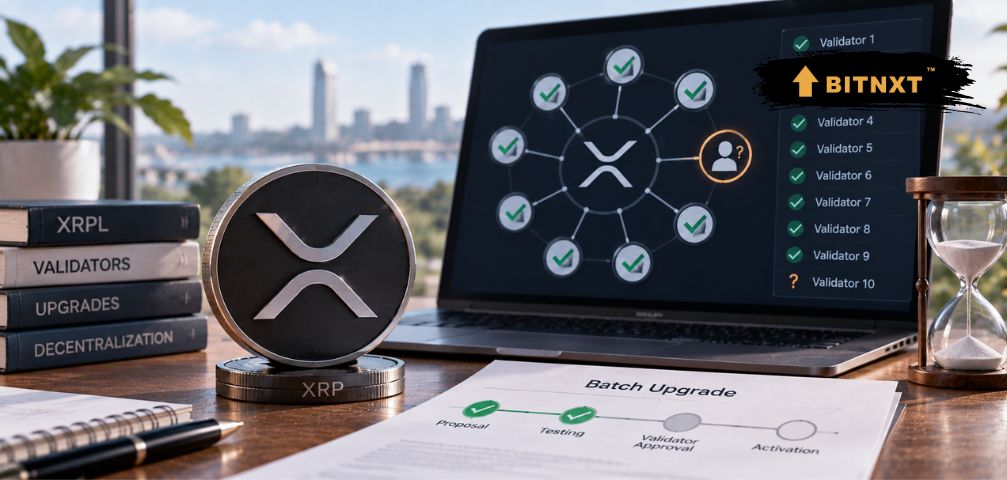
The XRP Ledger's most consequential upgrade in months is one validator vote from activation. Batch V1.1, shipped in rippled version xrpld 3.3.0 on August 6, now holds 27 of 35 unique node list validator votes, about 77%, against the 28-vote, 80% threshold it must sustain for 14 consecutive days to go live, with support having grown from 24 votes on September 8. The feature itself is a settlement primitive: it bundles up to 8 transactions, token swaps, fee splits, multi-step payments, into a single atomic operation that either fully executes or fully fails, the kind of building block institutional payment workflows need before they can treat an L1 as infrastructure rather than a laboratory. RippleX software engineer Mayukha Vadari's account of the road here is unusually candid about the failure that preceded it: "The Batch V1.1 amendment shipped in xrpld 3.3.0 and is now up for voting. After the v1.0 signature bug was caught in February (pre-Mainnet, no funds at risk), we rebuilt it: root-cause fix, 4 senior reviewers, a Sherlock attackathon, and audits from Halborn and Common Prefix."
The v1.0 flaw was not cosmetic: a pre-mainnet authorization weakness, with a critical follow-on found by audit firm Common Prefix allowing signed permissions to be reused for unauthorized transaction placement, meant the original design could have let unapproved transactions into batches.
The 11 Bugs and the Standard They Set
The V1.1 rewrite's security stack is the story worth dwelling on, because it sketches a model other L1s quietly avoid. Eleven bugs were fixed across signatures, authorization logic, and server crash vectors, surfaced through four senior internal reviewers, Halborn's audit, Common Prefix's audit, and a Sherlock attackathon, a crowdsourced exploit hunt, all before a single mainnet byte moved. The historical precedent inside XRPL's own governance shows the discipline is systemic, not exceptional: amendment voting has recently activated fixes at 85.71% support and reset 14-day windows when consensus dipped, most recently with the fixCleanup3_2_0 amendment on July 29, and the xrpld 3.3.0 suite ships alongside Confidential MPT, Dynamic MPT, Sponsor, and the Permission Delegation amendment that Ripple backed in August. That process, visible validator votes, rolling two-week windows, audit trails published before activation, is the same governance transparency standard that Solana's validator upgrades through Jito have been measured against this year, and it is the quiet competitive advantage of chains whose feature launches read like court proceedings rather than product drops. Vadari also noted unnamed commercial projects are under contract building on Batch before it has even activated, a demand signal that explains the care.
Why One Validator Vote Matters
The UNL governance structure concentrates consequence in a way larger chains' votes do not: 35 validators decide, and a single operator switching stance can delay or advance a flagship feature. That is both XRPL's efficiency, activation is legible and fast when consensus exists, and its critique, the honest sentence is that 28 of 35 named nodes determine what the ledger can do, a smaller governing set than most networks would accept for a settlement feature aimed at institutional users. The counter-argument: every UNL operator runs in daylight, the vote tallies are public, and the 14-day sustained-support rule prevents any single moment's enthusiasm from shipping code, the same conservatism that caught v1.0's bug before it could matter. For the ecosystem's commercial hopes, atomic batching is the prerequisite for payment-splitting, escrowed swaps, and the multi-leg workflows that corporate treasuries actually run, which is why the vote count, not the press release, is the real product news this week.
What to Watch
Watch the 28th vote, which could land any day and starts the 14-day clock; watch whether support holds above 80% through the window, since a dip resets it entirely; and watch the first commercial integrations announced on Batch post-activation, which will test whether the institutional demand the rewrite was built for converts. XRPL just spent seven months proving it would rather be late than dangerous. The market gets to decide what that is worth.


