

























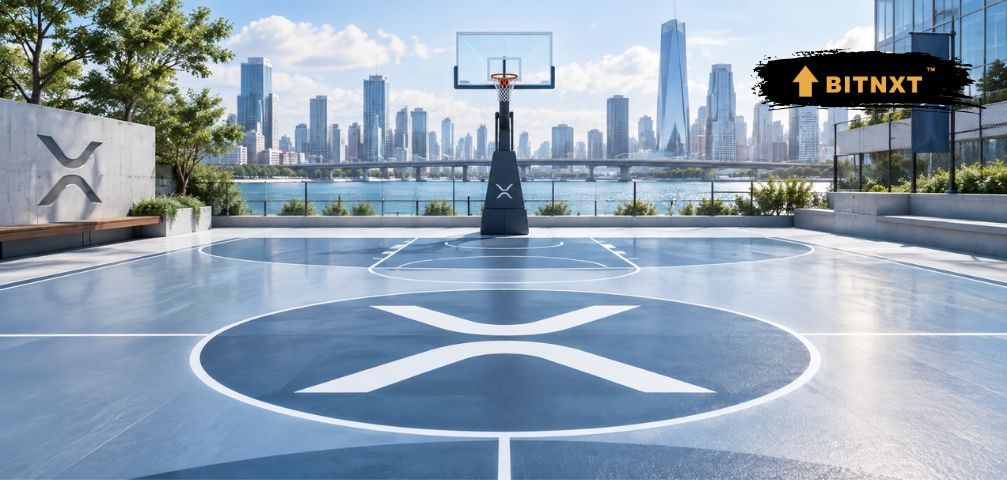
Ripple is buying the most visible advertising surface in American college sports, one court at a time. Louisville Athletics announced a multi-year brand partnership on September 15, brokered by Learfield Sports Properties, that will put the XRP logo on Denny Crum Court inside the KFC Yum! Center starting with the 2026-27 season, for both men's and women's home basketball games, with placements spanning courtside broadcast signage, venue branding, digital channels, and radio. Financial terms were undisclosed. Athletic director Josh Heird's framing was brand-equity talk: "Ripple was very intentional about aligning with premier basketball brands, and we're proud that Louisville was one of the programs they identified." The deal is Ripple's second NCAA arrangement in two weeks, following the September 4 college football partnership with Florida Gators Athletics, and it lands the same week Senate Republicans proposed classifying secondary XRP sales as digital commodities in the CLARITY Act draft.
Learfield president Kim Damson supplied the sales pitch Louisville sold: "one of the most respected programs in college basketball, providing an extraordinary platform for brand partners to engage fans not only locally but on a national scale."
The Strategy Behind the XRP Logo on the Court
The pattern across the two deals explains the spend: Ripple is building mainstream American brand recognition for a token whose regulatory fate is being decided in Washington, and college athletics is the cheapest mass-market reach available, broadcast hours, loyal fanbases, and a demographic, 18-to-24-year-olds, that surveys consistently show is the most crypto-curious. The timing is deliberate. With the CLARITY Act's XRP commodity language in negotiation and prediction markets still digesting the cloture vote's arithmetic, a visible campaign that says normal, trustworthy, on the court next to a basketball dynasty is a bet that public brand equity moves political and institutional calculus, the same logic that drove the marquee athlete partnerships spreading across the prediction-market and sports-marketing nexus. The court deal's education component, Ripple sponsoring financial and tech education on traditional finance and digital assets for Louisville student-athletes and the campus community, is the other half of the playbook: it converts an ad buy into a curriculum, which buys goodwill that a logo on hardwood cannot buy alone, and it plants the NIL-era relationship seed with the next generation of financially literate athletes.
The Skeptical Read of Ripple's NCAA Blitz
What the deal does not do matters just as much for honest analysis. Court sponsorships do not drive XRP Ledger utility, payment integration, or institutional adoption, the logo's audience will not conclude its remittance settlement is superior, and the spend's measurable return is awareness, not throughput, which makes it brand expenditure with the same unanswerable ROI problem as every sports sponsorship in history. The persistence question deserves airtime too: the court retains Coach Denny Crum's logo inside the three-point arc, Heird made a point of "continuing to honor Coach Crum and the legacy of Denny Crum Court," and the school clearly negotiated to protect a sacred surface, but fans' tolerance for crypto logos on historic courts is a live reputational variable for both brands. The counter-argument for Ripple is straightforward: at the exact moment its token's legal status is being drafted, being seen as a household American brand rather than a courtroom defendant is strategically cheap at any undisclosed price, and after years of SEC litigation defined XRP's public image, buying a basketball court is arguably the most normal thing the company has done in half a decade.
What to Watch
Watch whether the NCAA campaign expands beyond the two Florida and Louisville deals, which would signal a season-long, seven-figure marketing push rather than a test; watch the fans' courtside reaction when the XRP logo debuts, because organic mockery would be a marketing outcome no contract controls; and watch whether the CLARITY Act's XRP language survives the next Congress, since the brand campaign and the legislative battle are two fronts of the same campaign for XRP's American identity. Ripple spent years in court. Now it is spending on courts, and the second arena is the one where public opinion actually lives.


