



























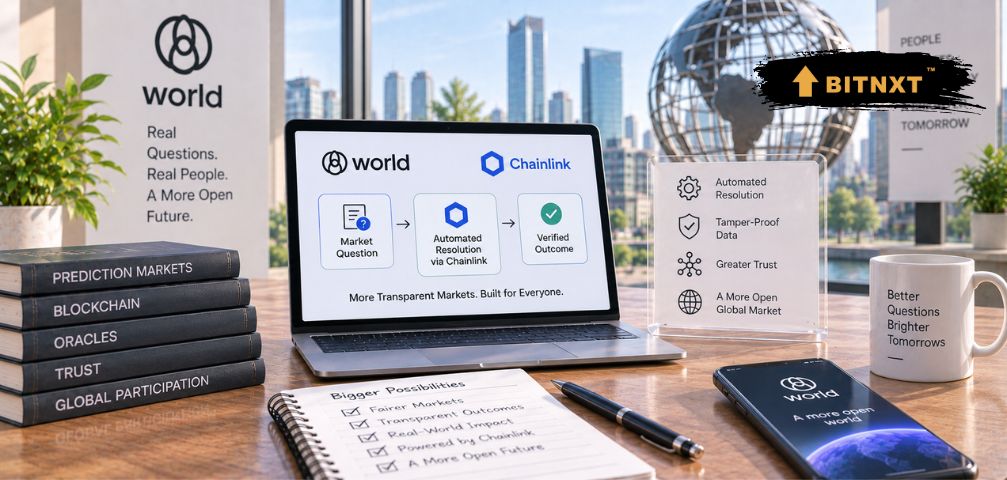
The World prediction market has picked a third way to answer the hardest question in event trading: who decides what happened, and when. World, which opened its prediction market to more than one million waitlisted users after its September 9 standalone launch at world.xyz, now settles eligible markets programmatically through Chainlink Data Streams and the Chainlink Runtime Environment. Payouts execute the moment an event concludes. No panel. No vote. No dispute window. The platform has already created more than 150,000 markets across every NFL game, seven soccer leagues, Formula 1, the 2026 U.S. midterms, and Federal Reserve rate decisions, with binary contracts priced $0 to $1 and winning positions settling at $1 in CASH, Phantom's stablecoin, on Solana.
What makes the architecture notable is what sits outside it: no exchange registration, no brokerage account, no custody. The non-custodial protocol routes orders to Solana liquidity providers, which is why the Solana Foundation's head of DeFi called it "a new asset class while keeping liquidity fully on chain." The site's brief crash under waitlist traffic on launch day was the least interesting failure mode on offer.
What the World Prediction Market's Third Model Changes
Put the three resolution philosophies side by side and the design choices sharpen. Kalshi, which has spent heavily on institutional credibility including election-market data distribution, resolves through a rulebook operated by a CFTC-regulated designated contract market, with human error-correction discretion. Polymarket, whose sports push runs from World Cup markets to marquee athlete partnerships, uses an optimistic oracle with token-holder voting during challenge windows. World's third model removes the humans: a Chainlink data feed settles the contract automatically when the game ends. For objective events with clean data sources, a final score, a Fed decision, a match result, this is strictly better: instant settlement, no dispute latency, no governance token to game. The trade-off is the one the reporting on this launch flagged precisely: every mechanism that removes discretion also removes correction. If a feed reports the wrong score, there is no panel to fix it and no appeal to file. The failure mode is not slower payouts. It is unfixable wrong ones.
Scale, Funding, and the Regulatory Gap
The commercial context explains the speed. Kalshi raised roughly $1.12 billion cumulatively, with about $380 million remaining under an SEC notice after its Series F at a $22 billion valuation, and Polymarket's World Cup market alone hit $4.3 billion in volume in late July. World's bet is that resolution speed plus wallet-native distribution, zero brokerage onboarding, Phantom's installed base, and Solana's fee structure, undercuts both incumbents on the events where latency matters most, which are exactly the events, sports and macro, that dominate volume. Equities, commodities, and weather markets are planned next, and weather is where the automation claim gets stress-tested, as ESMA just documented a Polymarket weather-market manipulation case involving tampered sensors.
Then the gap: World is running sports and election markets without DCM licensing, into the same state regulatory fire, New York lawsuits, the California tribes' Ninth Circuit fight, that is battering the licensed incumbents. Programmatic resolution does not create regulatory immunity, and an unfixable wrong payout on a political market is precisely the incident that regulators would use. Watch whether World publishes a feed-error policy before its first high-profile automation mistake, and whether CFTC staff treat a no-dispute-window oracle as an unregistered DCM function. The third model is the fastest settlement in prediction markets. It is also the one with no undo button.


