





























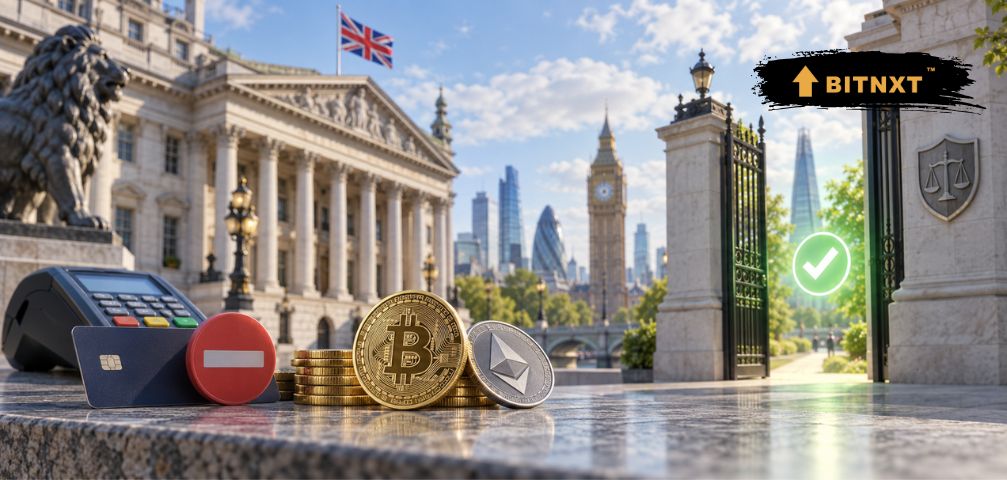
Nine of Britain's ten largest retail banks still block or limit payments to crypto exchanges, and nothing in the UK's new regulatory regime, whose authorization gateway opens September 30, forces them to stop. The Financial Conduct Authority published guidance on September 16 helping crypto businesses identify whether their activities will require authorization when the full regime begins on October 25, 2027, with applications running from September 30 through February 28, 2027, and the framework covers qualifying stablecoin issuance, trading platforms, custody, dealing, arranging and staking. What it does not cover is the friction users actually experience: bank-side payment restrictions sit entirely outside the authorization process, HM Treasury told Parliament in March that banking decisions remain "largely commercial in nature," and industry research cited by The Block estimates roughly 40% of UK bank-to-exchange transfers are blocked or delayed today, with 80% of surveyed exchanges reporting increased customer friction over the past year.
The gap between a regulated crypto sector and a bankable one is the story, and it has a deadline: firms that miss the five-month gateway risk having to stop regulated activities in 2027 while their applications pend.
The Restriction Map, Bank by Bank
The variation across banks is the detail most users miss until a payment bounces. Barclays caps transfers to crypto exchanges at £2,500 per transaction and £10,000 per calendar month, with a £10,000 monthly debit-card limit, and Barclaycard stopped crypto transactions entirely in June 2025. HSBC applies the same £2,500 single-payment and £10,000 rolling 30-day ceilings to bank and debit payments, and prohibits credit-card purchases. NatWest is tighter still at £1,000 per day and £5,000 per 30 days, a policy it introduced for scam protection. Santander limits identifiable crypto-exchange payments to £1,000 per transaction and £3,000 per 30 days, and separately blocks payments it can identify as destined for Binance. Nationwide allows crypto purchases but sets a £1,000 daily limit on most accounts, Monzo applies a fixed £5,000 rolling 30-day allowance customers cannot increase, Chase UK blocks every outbound cryptoasset payment it identifies while permitting inbound transfers from platforms, and Metro Bank has not processed outbound payments to known exchanges since November 2024. TSB's business terms permit refusal of exchange payments under fraud-risk categories, and Starling applies restrictions varying by product. Nine of the top ten, with the limits differing only in severity.
Why FCA Authorization Does Not Unlock Bank Rails
The regulatory logic is worth stating precisely, because it looks like a contradiction and is not. FCA authorization establishes that a crypto business meets the regulator's standards for its approved activities, prudential requirements, client-asset custody rules, Consumer Duty, operational resilience, the June policy package the FCA now layers onto authorized firms. It says nothing about a bank's own financial-crime, fraud and customer-risk appetite, which is why NatWest directs customers to check whether an exchange is FCA-registered while maintaining its £1,000 daily cap, and why the government's expectation of fair treatment for licensed firms, Treasury said it "would not expect" FCA-licensed crypto companies to face restrictions merely for operating in crypto, is a hope stated in a parliamentary answer rather than a requirement written into law. Industry groups are fighting the arrangement: Stand With Crypto UK launched a June campaign asking members to challenge bank restrictions, and the UK Cryptoasset Business Council's 40% blockage estimate is the quantitative case. The unresolved policy question is whether Britain can position itself as a digital-asset hub, the government's stated ambition, while its banking system treats outbound crypto payments as presumptive fraud, and the same tension is visible in the bank-deposit war being fought over stablecoin yields.
What the September 30 Gateway Actually Delivers
The gateway's mechanics matter for every firm that has been treating UK registration as settled. AML registration under the Money Laundering Regulations does not automatically convert into authorization under the Financial Services and Markets Act regime, existing registered firms must apply for the new permissions, and firms filing inside the window qualify for transitional arrangements if their applications are undecided when October 25, 2027 arrives, while late applicants could need to halt regulated activities mid-wait. The FCA is running pre-application meetings and webinars, Treasury amended the underlying legislation on September 15 to add exclusions for stablecoin payments, technology providers and related areas, and an October FCA consultation will address perimeter questions including qualifying stablecoins, proprietary trading, market making, decentralized protocols and safeguarding, following the June final rules. The regime's breadth is real, custody client-asset requirements cover ownership records, reconciliation and private-key management, and FCA executive director David Geale framed the goal as a framework "that firms, consumers and international partners can trust," the same institutional-direction argument behind the UK's tokenized-gold exemption work.
What to Watch
Watch the gateway's first-week application volume, which will reveal how many AML-registered firms actually intend to operate in the regulated regime; watch whether the 2027 launch produces any coordinated political pressure on the banks' crypto-payment policies, since 40% blockage plus a licensed sector is an unstable equilibrium; and watch the October perimeter consultation, especially its treatment of decentralized protocols. Britain is building the rulebook. The banks are still building the wall, and neither is talking to the other.


