





























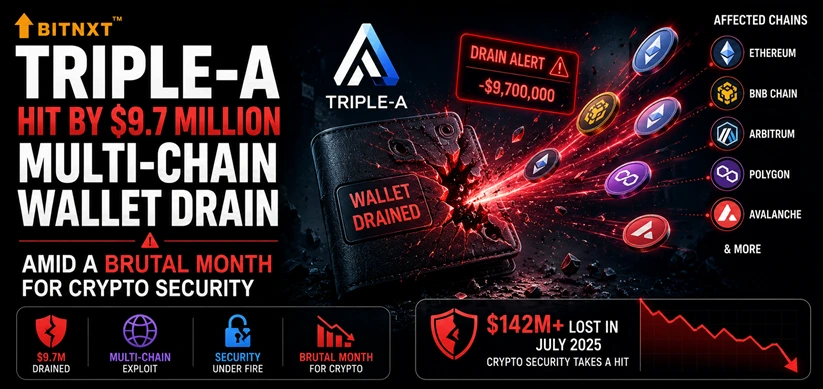
Triple-A, a Singapore-based crypto payments company, has reportedly been hit by a security incident in which more than $9.7 million was drained from wallets linked to the firm across multiple blockchains. The outflows were first flagged by on-chain analysts and later amplified by a blockchain security firm, landing in the middle of one of the most theft-heavy stretches the crypto industry has seen this year. Here is a research-backed, factual account of what has been reported so far, the firm’s response, and the wider context — with no technical or operational detail about how the compromise occurred.
What Happened
On-chain analyst Specter first identified suspicious transactions involving hot wallets linked to Triple-A, initially estimating that more than $9.3 million had been removed, swapped, and moved across chains to Ethereum. Blockchain security firm PeckShield subsequently amplified the alert, with later estimates placing the suspected loss above $9.7 million. According to the reporting, the attacker swapped the assets and bridged them to Ethereum, where the proceeds were consolidated into a single wallet holding roughly 5,227 ETH — worth about $9.7 million at the time. Most of the transfers reportedly occurred on July 24 and 25.
One detail analysts highlighted: the outflows appeared to be ongoing at the time of the alerts. As Specter put it, it looked as though the team was not yet aware, because deposits had not been disabled and each new deposit was being drained — a point relevant to affected businesses monitoring the situation, not a technical roadmap.
A Note on Conflicting Details
As is common in the early hours of an incident, sources diverge on specifics, and it’s worth stating that plainly. The reported loss ranges from about $9.3 million to more than $9.7 million as estimates were refined. The affected networks are also described differently: some trackers, including PeckShield, list TRON, Ethereum, Polygon, and Arbitrum, while others, citing Specter, list TRON, Ethereum, TON, and Solana. What the accounts agree on is the pattern — a multi-chain drain of hot wallets, followed by swapping and bridging to consolidate the funds on Ethereum. These figures may be revised as investigators publish more.
The Company’s Response
Triple-A has said it is looking into the matter. A spokesperson told BeInCrypto that the firm is actively investigating and will share a formal update as soon as possible, and stated that customer funds are not impacted. That said, other outlets noted that, at their respective press times, the company had not issued a fuller public statement confirming the cause, and had not specified whether the affected addresses were used for treasury, payment processing, customer deposits, or internal liquidity. Readers should treat the situation as developing and rely on Triple-A’s official channels for confirmed information.
Who Is Triple-A?
Context helps here. Triple-A is a regulated payments firm, not a fringe operator. It operates as a Major Payment Institution licensed by the Monetary Authority of Singapore, secured full MiCA authorization for digital-asset services in the European Union in the prior month, and received in-principle approval from Dubai’s VARA on July 15 for broker-dealer services. That regulatory footprint is part of why the incident drew attention: it underscores that even licensed, compliance-focused firms remain exposed to on-chain security risk.
You might also like: Your Crypto Finally Works Like Money: Kraken’s Card and the Race to Make Digital Assets Spendable
The Incident at a Glance
Item | Detail (as reported) |
Affected firm | Triple-A — Singapore-based crypto/stablecoin payments provider |
Reported loss | ~$9.3M initially, later estimated above $9.7M |
Consolidated into | ~5,227 ETH in a single Ethereum wallet |
Networks (per source) | TRON, ETH, Polygon, Arbitrum (PeckShield) or TRON, ETH, TON, Solana (Specter) |
Pattern | Multi-chain hot-wallet outflows, swapped and bridged to Ethereum |
First flagged by | On-chain analyst Specter; amplified by PeckShield |
Company statement | Investigating; says customer funds not impacted |
Part of a Wider Wave of Exploits
The Triple-A incident did not happen in isolation — it capped an especially rough week for crypto security. On-chain trackers at Lookonchain counted three separate attacks on July 23 totaling about $35.55 million: AFX Trade at $24.15 million, the Verus Ethereum bridge at $7.55 million, and B2 Network at $3.86 million. The Verus hit marked that project’s second exploit since May, when roughly $11.58 million was drained. Earlier in July, a Hedera-based lender saw about $9 million drained, and a bridge protocol lost over $735,000 from a Bitcoin hot wallet. Reporting describes the recent stretch as one of the most hack-intensive in crypto history, with industry losses in 2026 already estimated well past $750 million by mid-year.
Why It Matters
For the crypto payments sector, the episode is a pointed reminder that security remains the industry’s hardest, most persistent challenge as adoption grows. Hot wallets — the internet-connected wallets payment providers use to move funds quickly — are convenient by design but represent a standing risk surface, which is why security professionals generally emphasize minimizing balances held online, rigorous key management, and layered operational controls. The broader takeaway is sobering but constructive: regulatory approval and real security posture are different things, and even well-licensed firms need continuous investment in defense. For affected businesses and users, the prudent step is to follow Triple-A’s official updates rather than act on unverified early figures.
Sources and Further Reading
BeInCrypto (via Yahoo Finance) – “Crypto Payments Firm Triple-A Hit by $9.7 Million Wallet Drain” (reference article; company statement)
crypto.news – “Triple-A hot wallets lose $9.7M in suspected exploit” (Specter estimates; network details)
Crypto Times – “Triple-A Hot Wallets Drained…” (broader exploit tally and 2026 losses)
CryptoAdventure / Coinpedia – on Triple-A’s regulatory status (MAS, MiCA, VARA) and consolidation details
PeckShield / Lookonchain – on-chain alerts and the July exploit wave
Note: This is a developing story; figures and affected-network details reflect early reporting from July 24–25, 2026, differ across sources, and may be revised. Nothing here is confirmed by the affected firm beyond its cited statement, and this article is for informational purposes only, not investment or security advice.


