



























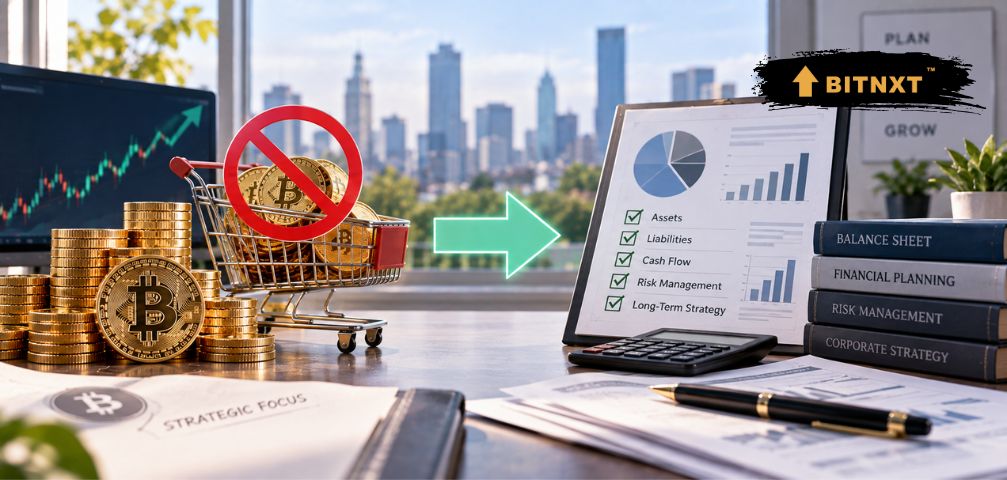
Strategy has stopped being Strategy, at least for two weeks. The company's September 14 Form 8-K confirmed zero Bitcoin purchases, zero Bitcoin sales, and zero common stock issuances under its at-the-market program for the week of September 8-13, marking two consecutive weeks without adding to its stash, and the last purchase on record remains August 31's 4,603 BTC for roughly $370 million. What the company did do with its capital is the real disclosure: $139.3 million in cash spent repurchasing 1,420,467 STRC preferred shares at an average of about $98 against $100 par value, following $176.3 million the prior week, bringing total STRC buybacks to roughly $811.5 million since July, about 2.25 times its last Bitcoin purchase, funded from a cash pile that has now fallen to $1.30 billion alongside a $5.10 billion USD reserve. The company's frame for the pivot is pure Saylor arithmetic: the buybacks represent, in his modeling, a 57 basis point BTC credit at a 3.9-year dollar duration, assuming 10% annual BTC returns, 40% volatility, and a $77,266 reference price.
The blunt editorial read, which the filings themselves invite: buying back preferred stock with cash while touching neither Bitcoin nor the share count is a company that has stopped operating its accumulation model and started managing its balance sheet.
Why the STRC Trade Beats Bitcoin, On Paper
The logic of the pivot is relative value, and it is genuinely compelling at these prices. STRC carries a dividend near 12%, which the company sources have described as an expensive perpetual liability, and buying it back at $98 extinguishes that obligation at a discount, generating, on Saylor's math, a better risk-adjusted return than buying BTC near the company's $75,412 average cost, where each incremental coin adds almost no leverage to the thesis. The problem is what funding it reveals: this is cash spending without matching ATM issuance, the machine that made Strategy unique was the perpetual conversion of equity into Bitcoin, and pausing both sides of that machine simultaneously, no buys, no issuance, means the 845,050 BTC stack is now static while the cash that defends it shrinks, the very rotation from Bitcoin into STRC buybacks we flagged when Strategy sold BTC to fund repurchases, now in its purest form. The buyback math also has public market corroboration of the value case, as analysts have argued STRC's yield structure justifies a premium to its print, and the $1.05 billion remaining preferred authorization plus $1.0 billion common ATM suggest the toolkit is not exhausted, merely re-weighted.
The Index Threat Nobody Is Pricing
The quieter story inside the filing window is the MSCI dispute. Saylor and CEO Phong Le petitioned MSCI in early September to retract a rule threatening Strategy's benchmark index inclusion, and the stakes explain the urgency: if the largest corporate Bitcoin treasury falls out of major indices, the passive funds that own it mechanically would stop buying, and Strategy's equity premium has always rested on the treasury-proxy valuation logic that index inclusion institutionalizes. A company simultaneously pausing accumulation and fighting its index custodians is managing two versions of the same risk: the market's willingness to pay a premium for Bitcoin exposure wrapped in equity. The two-week halt could be tactical, a pause ahead of the Fed decision with BTC near cost basis, or it could be the model's honest signal that near $78,000, buying more Bitcoin with fresh equity no longer prints the accretion that justified the machine for five years.
What to Watch
Watch next Monday's 8-K for the pattern's third data point, one more cash-funded STRC week makes it a regime, not a pause; watch the cash balance floor, since $1.30 billion of operating liquidity plus a $5.10 billion reserve gives the buyback program perhaps a dozen more weeks at this pace before it forces a choice; and watch MSCI's ruling, which would reprice the equity's passive demand independently of anything Bitcoin does. Strategy built the corporate Bitcoin era by never stopping. The market is now learning what its stop looks like.


