





























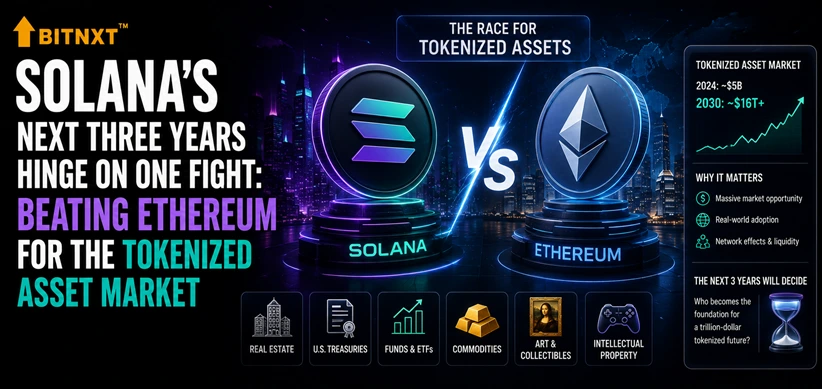
Solana's developers set themselves a deadline in July 2025. The “Internet Capital Markets” plan laid out a slate of features for the community to deliver by the end of 2027 — and since then the ambitions have grown even as the token's price has fallen, with SOL now trading around $77.51 against a 52-week range of $60.40 to $252.78. The question for the next three years is narrower than it looks: can Solana beat Ethereum to become the leading venue for tokenized asset management and trading?
Where Solana Already Leads
On some measures, it's winning decisively. Solana has passed 300,000 real-world asset holders — users holding tokenized stocks, bonds, or other traditional assets — more than any other chain, and it handled more than 96% of tokenized equity spot trading volume in June.
But volume isn't value. Ethereum still leads on total tradeable tokenized asset value by a wide margin: $15.5 billion against Solana's $3.3 billion. Solana is winning the trading activity while Ethereum holds the assets — and closing that roughly five-to-one gap is the central challenge of the next few years.
Alpenglow: The Technical Catalyst
The upgrade meant to change the equation is Alpenglow, Solana's consensus overhaul, which aims to cut transaction finality from about 12.8 seconds to roughly 150 milliseconds. It went live for testing in May, with mainnet debut due late this year after slipping from an original Q1 target.
The architectural shift matters as much as the speed. After rollout, the network will process traffic in parallel rather than in series, with smart contracts controlling transaction ordering — the setup required for on-chain markets to rival centralized exchanges on speed, at least in theory.
You might also like: Solana and Hyperliquid ETFs Quietly Command Nearly 80% of Altcoin Fund Flows — and HYPE Is Only Two Months Old
Two Proposals That Would Reshape SOL’s Supply
Beyond throughput, two Solana Improvement Documents could materially change the token's investment case. SIMD-0550 would accelerate the reduction in new SOL issuance, cutting the rate by 30% per year rather than the current 15% — roughly 18.9 million fewer tokens entering circulation. It's still inflation, but it would arrive at a permanently low, static rate far sooner than the protocol currently encodes.
SIMD-0553 would raise the daily token burn rate from about 648 SOL to somewhere between 7,500 and 9,000, adding supply pressure that could support higher prices over time. Neither is guaranteed: a more aggressive version of the burn proposal, SIMD-0228, failed to pass in March 2025, and both current proposals could meet the same fate.
Three Scenarios for 2029
The bull case: Alpenglow delivers its performance targets, SIMD-0550 clears its governance vote, and Solana's tokenized asset markets capture a substantial slice of tokenized stocks plus portions of tokenized private credit and structured products. That outcome currently looks reasonably likely.
The base case: the SIMDs pass partially or in diluted form, Solana's share of tokenized stocks grows modestly, and Ethereum wins the larger share of everything else — leaving SOL worth more than today by 2030, but without the decisive victory.
The bear case: both proposals fail, triggering broader network governance concerns that erode institutional confidence and push financial institutions to onboard their tokenized assets elsewhere. That scenario is less about technology than trust — and it's the reason governance votes over the next few years may matter more to Solana's trajectory than any single upgrade.
Source: Analysis via The Motley Fool (Alex Carchidi). The author holds positions in Ethereum and Solana. Scenarios described are the analyst’s projections, not forecasts of certain outcomes. This article is for informational purposes only and is not investment advice.


