





























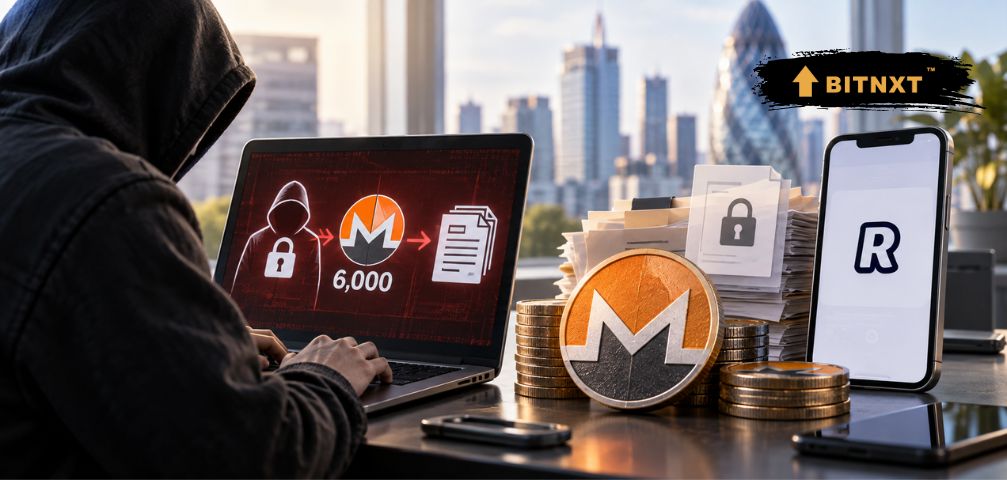
The hackers behind the Revolut data breach have set their price: 6,000 Monero, roughly $3 million at an implied $500 per token, delivered within 24 hours or the stolen customer records go up for sale to other criminal groups. A group calling itself iamnotavillain published the Revolut ransom demand on Wednesday alongside a countdown clock, according to a Financial Times report, and backed it with a 60-second screen recording showing passports, driving licences, know-your-customer verification photos and complete customer transaction histories. At least 680 accounts are affected, the number at the center of the ICO investigation that opened after Revolut reported the incident, and one Revolut has only publicly described as a very limited portion of its customer base.
What the Revolut Ransom Demand Reveals
Three details in the FT report deserve attention beyond the headline number. First, the currency choice: Monero, the privacy coin built to conceal sender, recipient and amount, is the standard tool for ransom demands precisely because its ring signatures, stealth addresses and RingCT amounts make payment trails difficult to follow. Second, the targeting method: the hackers told the FT they used blockchain analysis to select Revolut customers who appeared to hold substantial cryptocurrency, which corroborates the earlier picture of a breach that began with fraudulent government data requests passing Revolut's checks and skewed toward high-net-worth users, as on-chain investigator ZachXBT had assessed. This was not a random haul; it was a curated list of crypto-rich identities. Third, the silence: no negotiations had taken place by publication time, Revolut has not confirmed the group controls the data, and the company has not said whether it will respond.
The breach mechanics are already documented. The attackers never broke into Revolut's systems; they posed as government officials using an email account on a legitimate agency's domain with valid authentication credentials, and Revolut supplied the records before discovering the requests were fraudulent. The disclosure included full names, dates of birth, addresses, occupations, contact details, passport and licence copies, verification selfies, IBANs, account data, withdrawal records, complete transaction histories, and in some statements Bitcoin wallet reference numbers and transaction records. Revolut has said its systems and customer funds were never compromised, and that biometric facial telemetry was not included.
Why the Stolen Data Is a Weapons Cache
The combination is what makes this cache dangerous: verified identity documents on one side and on-chain transaction history on the other. Public blockchains expose wallet balances and flows, but tying a wallet to a legal identity requires exactly the kind of bridge records Revolut just leaked. Whoever holds this dataset can connect named individuals to their crypto activity with high confidence, which converts every affected customer into a target for precision phishing, extortion and the wrench attacks that physical crypto crime increasingly favors, the same playbook that produced the seed-phrase vault raids Irish gangs have perfected.
That risk travels. The FT report did not specify whether any of the 680 accounts belong to U.S. customers, but the exposure pattern is identical everywhere: accurate personal information does not prove a caller represents the bank. Revolut's own U.S. guidance says the company will not unexpectedly call customers asking for payments or security codes, and the FTC routes identity-theft response through IdentityTheft.gov. The FBI's IC3 asks crypto-fraud reports to include wallet addresses, transaction amounts, hashes and timestamps, which is precisely the data type now sitting in a criminal group's hands.
The Monero Question Nobody Should Oversimplify
The ransom currency will reignite the privacy-coin debate on schedule, so the record should be straight. Monero's design makes illicit payment trails harder to trace than transparent networks like Bitcoin or Ethereum, which is why ransom groups choose it, and a parallel August case showed investigators tracking funds from a reported $7.9 million hack through exchanges before some assets were converted to XMR. Criminal preference does not indict the token or its users: Monero also serves ordinary financial privacy, and the same properties that frustrate kidnappers' investigators frustrate dissidents' persecutors. The uncomfortable fact for law enforcement is simpler: a 24-hour Monero deadline is designed to expire before any freeze order can reach it.
What Happens Next
Watch three things. First, whether the 24-hour clock expires with a data dump: if the records hit criminal markets, expect a wave of targeted fraud against the 680 affected customers, likely within weeks, and expect other carriers of KYC data, exchanges and fintechs included, to check their own government-request verification flows. Second, the ICO investigation: a regulator with the power to fine up to 4% of global turnover now has a ransom demand in the public record as aggravating context. Third, whether Revolut names the government agency whose email domain was used, the detail the company has so far declined to provide, and which determines whether this reads as one bank's process failure or a systemic weakness in how agencies authenticate data requests. The breach was an impersonation scam. The ransom is the business model that impersonation now feeds.


