





























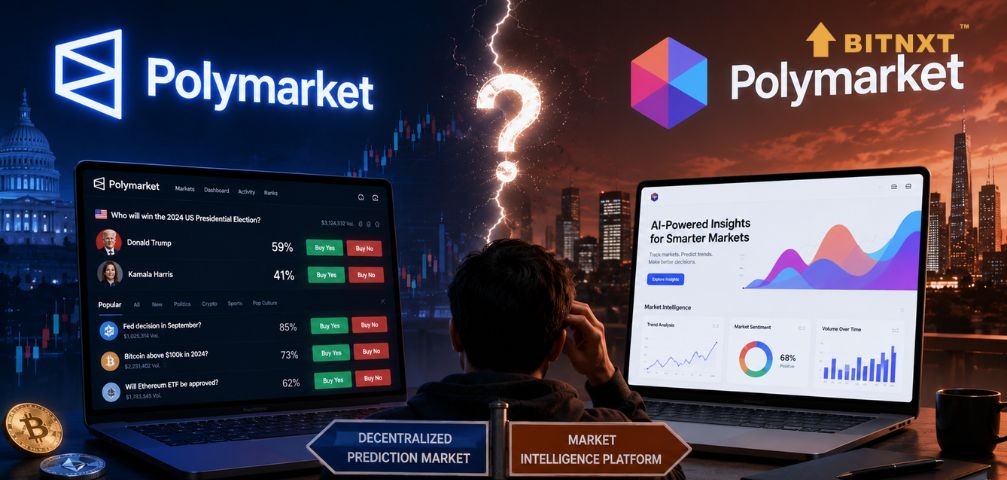
Anyone still picturing Polymarket as a single platform is working with outdated information — that description stopped being accurate back in December. Today, "Polymarket" actually refers to two distinct, legally separate businesses that happen to share a brand name, an interface style, and increasingly a rulebook, but almost nothing else.
The Original: A Wallet, No ID, No Questions Asked
The platform most crypto users are familiar with is the international version — a blockchain application where markets settle on Polygon, positions are collateralized in stablecoins, and access requires nothing more than a self-custodial wallet. There's no traditional account, no identity verification, and no intermediary standing between the trader and the market. Positions exist as tokens sitting in a wallet address, trades execute against a public on-chain order book, and outcomes are settled through a decentralized oracle dispute process. Geographic restrictions are enforced purely by IP address — the platform can block an entire country without ever knowing who any individual trader actually is.
The New One: A Federally Licensed US Exchange
Sitting alongside it is Polymarket US, an entirely different animal. It operates through a CFTC-licensed exchange and clearing entity the company acquired in 2025 for a reported $112 million. After receiving an amended designation order in late November, the US exchange formally opened to users on December 2. This is a fully regulated designated contract market — meaning it lists contracts under federal derivatives law, clears trades through a registered clearing organization, and carries all the compliance obligations that come with that status. Users must complete full identity verification — government ID, Social Security number, proof of residency, and a live selfie — and fund their accounts in actual dollars through approved intermediaries rather than connecting a crypto wallet.
The simplest way to tell which one you're using: if you connected a wallet, you're on the international platform. If you uploaded ID and took a selfie, you're on the regulated US exchange.
Four Differences That Actually Matter to Traders
Custody: International platform positions are self-custodied tokens — no one can freeze them, but no one can recover them if you lose your keys either. US exchange funds sit within a regulated system with built-in protections, though the trade-off is the platform can restrict or suspend accounts under its own rules.
Settlement currency: Stablecoins on Polygon internationally; actual dollars through approved intermediaries domestically — a difference that affects funding speed, withdrawal times, and tax recordkeeping.
Identity requirements: None internationally; full verification (ID, SSN, liveness check) domestically — the verification is what makes the US exchange's compliance and sanctions-screening systems actually work.
Availability: The US exchange dropped its invite-only waitlist in May and is currently available via iOS only. The international platform remains geoblocked from the US and more than twenty other countries — and using a VPN to bypass that restriction violates the platform's terms and risks account closure.
Why the Products Themselves Are Different
Because the US exchange operates under federal derivatives law, it's restricted in what it's legally allowed to list. The international platform, sitting outside that regulatory perimeter, can offer markets on subjects the regulated exchange simply cannot — including contracts tied to armed conflict or leadership changes. Two users on what looks like "the same app" may actually be looking at completely different sets of tradable questions.
You Might like this also : A Single-Share Trade in Seoul Triggered a 17.9% Flash Crash in Hyperliquid's SK Hynix Perpetual Contract
Resolution mechanics also diverge sharply. International markets settle through a decentralized "optimistic oracle" process involving proposals, a challenge window, and token-holder voting on disputes. The US exchange resolves disputes under its own formal rulebook, backed by standard exchange-level accountability and recourse.
Why This Split Exists in the First Place
The structure traces directly back to enforcement history. In January 2022, the CFTC settled charges against Polymarket for running an unregistered facility for event-based binary options, hitting the company with a $1.4 million penalty and requiring it to stop serving US users. Rather than exit the US market permanently, the company later acquired an existing CFTC-licensed exchange outright — a faster route to compliance than applying for a license from scratch. Federal investigations closed in 2025, clearing the path for the amended designation order and the December launch.
Is This Two-Track Setup Permanent?
Signals point in both directions. In March, the company published harmonized market-integrity rules — covering insider trading, spoofing, wash trading, and front-running — applied consistently across both platforms, suggesting an eventual convergence. More directly, the company filed with the CFTC in April seeking permission to let US users access the larger, more liquid international exchange, a move that — if approved — would begin dissolving the separation altogether. A margin trading license application followed in July.
The volume gap explains the urgency behind that push: the international platform cleared a record $10.8 billion in June alone, driven heavily by World Cup markets, compared to just over $3.5 billion on the regulated US exchange. The deepest liquidity and widest market selection currently sit on the side American users legally cannot access — an awkward dynamic for a company headquartered in New York.
What Traders Should Actually Check Before Using Either Platform
Beyond knowing which venue you're on, the practical checklist includes: whether your specific market of interest even exists on that platform (since scopes differ), understanding the resolution process that will determine your payout, and verifying current legal availability in your jurisdiction — since state-level legal battles over prediction markets remain unresolved in several US states, with at least one enacted state ban already facing a court challenge.


