





























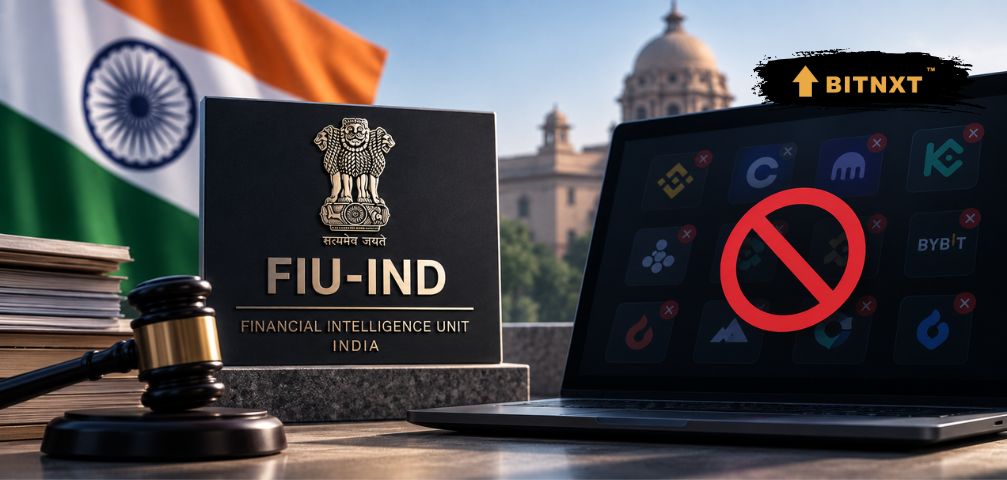
India's Financial Intelligence Unit issued non-compliance notices against 15 offshore crypto platforms on Tuesday and ordered their apps and URLs blocked, and the list is a map of where Indian retail money actually goes: Weex, Blofin, Rezorex, Bitunix, DigiFinex, Toobit, XT.com, Latoken, WOO X, Pionex, ChangeNow, SimpleSwap, Fixedfloat, WhiteBIT, and Guardarian. The notices run under Section 13 of the Prevention of Money Laundering Act, with takedown orders under Section 79(3)(b) of the IT Act. Since March 2023, the VDA framework requires any platform serving Indian residents to register with FIU-IND, run KYC, keep transaction records, and file suspicious activity reports, regardless of physical presence in the country.
The trigger is specific and worth understanding, because it is not about terror finance this time. The Economic Times reported that Indian traders have been moving USDT to offshore platforms in Sweden, Germany, and Singapore that convert it into retail gift cards, redeemed in India for groceries, fuel, and gold. The rail keeps funds entirely off domestic exchanges and outside the 30% flat capital gains tax and the 1% Tax Deducted at Source levied on every transaction. FIU's own notice carries the standard warning that crypto products "are unregulated and can be highly risky," but the enforcement logic is fiscal: India's tax regime routed an estimated 80% of domestic trading volume offshore, and the takedown list is the government closing the exits.
The Binance Blueprint, Applied Downmarket
There is a playbook here, and it worked once. In December 2023, FIU-IND sent show-cause notices to nine major exchanges including Binance, Kraken, and KuCoin, with URL blocks requested through the IT ministry. Binance registered with the FIU and paid a record penalty of INR 18.82 crore, roughly $2 million, for past lapses. What the 2023 wave proved is that India can force registration from platforms that want the market badly enough. What today's list proves is the second wave's different texture: these are mid-tier derivatives venues and instant swap services, the ones that grew specifically because the majors complied. Notably, the inclusion of non-custodial swap frontends like Fixedfloat, ChangeNow, and SimpleSwap, which operate without user accounts, marks the first time the enforcement net has explicitly extended past order-book exchanges to non-custodial rails, the same category of venue regulators across Asia have been raiding in parallel enforcement drives and that UK authorities keep flagging in their own warning lists.
The skeptical case for the platforms is that domain blocks are speed bumps. Indian users routinely bypass ISP blocks with VPNs and mirror domains, and a swap service without accounts has little to seize. The skeptical case for the users is harsher: balances left on flagged platforms face genuine lockout risk if the block lands before withdrawals clear. Either way, the platforms on the list now face the Binance decision, register and absorb the surveillance and tax plumbing, or write off a market of over a billion people.
Watch two things: whether any of the 15 register within the notice window, and whether the gift card corridors named in the Economic Times reporting become their own enforcement target. The exchanges were the easy half.


