





























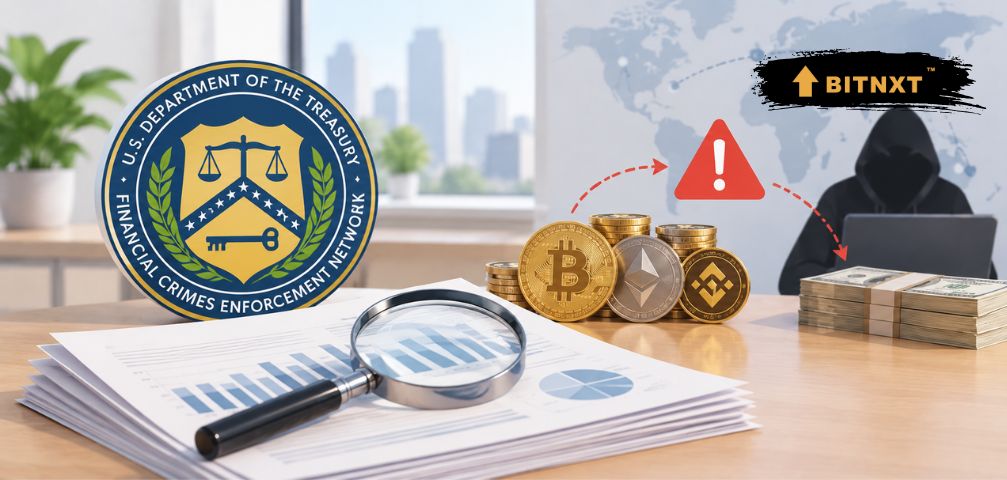
FinCEN has linked approximately $12.7 billion in suspicious financial activity to crypto investment scams run largely from overseas compounds — a two-year analysis of nearly 34,000 bank secrecy filings that maps, in unusual detail, how "pig butchering" networks turn trust into stablecoins and how deeply the pipeline runs through the US financial system.
The Treasury's Financial Crimes Enforcement Network said its analysis covered 33,904 Bank Secrecy Act reports filed by roughly 1,300 financial institutions between Sept. 8, 2023 and Dec. 31, 2025. Money services businesses — mostly crypto firms — filed 55% of the reports, flagging $5.5 billion; banks accounted for 41% and $6.4 billion; securities firms and other institutions flagged $784.5 million. Reporting accelerated throughout the period: monthly filings rose an average of 10.9% and reported amounts an average of 18%, from 590 reports covering $485.7 million in October 2023 to 2,482 reports covering $833.5 million by December 2025. FinCEN cautions the $12.7 billion is not a direct loss measure — reports can include attempted transactions and double counting — but the trend line is the finding.
How the crypto investment scam money moves
The laundering pattern is the report's sharpest detail. Scammers used at least 22 digital assets — Ethereum, Tether's USDT and Circle's USDC most commonly — but regardless of what victims initially bought, blockchain analysis found proceeds were usually converted into stablecoins, almost exclusively USDT, before being routed through DeFi protocols or exchanges outside the United States. Repeated use of the same collection addresses gave institutions a trail: some identified addresses receiving transfers from multiple victims at once, connecting seemingly separate transactions to a single network. That stablecoin dependency is precisely what enabled last year's counter-strike — the Secret Service worked with Coinbase to trace and recover USDT tied to pig butchering schemes, and the Justice Department sought seizure of $225 million in USDT linked to Southeast Asian fraud networks. The scams' own liquidity is becoming their fingerprint.
The victim profile complicates the conventional wisdom. Older Americans appeared in roughly 25% of filings — close to their 24.4% share of the population — leading FinCEN to conclude elders were neither disproportionately victimized nor disproportionately deprived within the dataset, though the damage remained severe: the FBI recorded $4.8 billion in fraud losses among Americans over 60 in 2024, a figure cited by senators behind the GUARD Act's blockchain-tracing funding. More striking is how victims financed the transfers: retirement accounts, home equity lines of credit, second mortgages and personal loans. One woman moved nearly $640,000 from her retirement fund; another victim lost more than $1 million over six months. FinCEN devoted part of its analysis to the psychological toll, warning some victims face self-harm risk after discovering the theft, and directed people in crisis to the 988 Suicide and Crisis Lifeline.
The trafficking economy behind the scams
FinCEN's analysis connects the money to its source: industrial-scale scam compounds in Cambodia, Laos and Burma, where workers recruited through fake job offers are confined and forced to run fraud. The United Nations estimates hundreds of thousands of people have been trafficked into such operations, and Interpol warns the model has spread beyond Southeast Asia. Chainalysis found in February that crypto-linked trafficking payments rose 85% in 2025 across tracked services, including labor recruiters tied to the compounds. The financial response is escalating in parallel: the FBI and Thai police froze roughly $580 million in cryptocurrency and seized about 8,000 phones in a March operation against organized pig butchering groups, and US and UK authorities have launched joint actions against the scam-center economy.
For the crypto industry, the report is both indictment and roadmap. The same transparency that lets FinCEN describe the laundering route in public — and lets security teams warn about credential fraud in real time — is what makes recovery operations like the $225 million seizure possible. The uncomfortable truth in the data is that most of the $12.7 billion flowed through regulated institutions' own filings before it ever became a statistic: banks watched second mortgages turn into USDT and reported it. Exchange data exposure keeps lowering the cost of victim targeting, which means the industry's fraud controls are not a compliance line item — they are the front line of a $12.7 billion problem that, on FinCEN's own trend line, is still growing.


