





























Vote math keeps the crypto lobby awake at night
The September cloture vote is procedural, not final. It requires 60 votes to advance the bill to full Senate floor debate, where amendments and a final passage vote would follow. But the procedural hurdle is the one that matters. If the motion fails, the Clarity Act is effectively dead for 2026, and midterm politics will prevent any serious attempt at comprehensive crypto legislation until 2029 at the earliest.
Republicans control 53 Senate seats. Under normal circumstances, that would mean they need seven Democrats. Senator Rand Paul opposes the bill on libertarian grounds, arguing that any broad federal regulatory framework represents government overreach. Senator Josh Hawley objects to what he views as favorable treatment for large financial technology companies at the expense of smaller competitors. Senator Thom Tillis has signaled he will withhold support absent stronger ethics language.
If three Republicans defect, leadership needs 10 Democratic votes. In the Senate Banking Committee, exactly two Democrats crossed over to advance the bill. The gap between two and 10 is vast, and the seven Democrats closest to crossing have not moved from their position that the current draft falls short.
Ethics fight over Trump crypto income
The single most politically charged provision in the Clarity Act has nothing to do with technology. It concerns whether elected officials and senior government appointees can own cryptocurrency businesses while serving in office. During the Senate Banking Committee markup on May 14, Democrats sponsored an ethics amendment that would have barred the president, vice president, and members of Congress from owning or participating in cryptocurrency businesses. The amendment failed 13 to 11 on a party-line vote.
President Trump disclosed more than $1.4 billion in crypto-related income in 2025, primarily from World Liberty Financial and the TRUMP memecoin. Democrats argue that passing a crypto regulatory framework without ethics guardrails creates a direct financial benefit for the sitting president. Republicans counter that the ethics provisions Democrats want would effectively prevent any lawmaker with a retirement account containing crypto exposure from voting on the bill, a standard applied to no other asset class.
The current draft includes a conflict-of-interest disclosure requirement with a sunset provision, but seven Democratic senators issued a joint statement saying the draft falls short on ethics enforcement, consumer protection, and illicit finance provisions. That language left room for negotiation but also gave each senator cover to vote no if the text does not change.
Three blocking issues remain unresolved
Three disputes block passage beyond the ethics fight. DeFi developer liability under Section 604 remains contentious, with concerns that the current language could expose software developers to liability for actions taken by users of their code. A stablecoin yield provision threatens approximately $1.35 billion in annual Coinbase USDC rewards revenue, with the exchange and its allies pushing to preserve the ability to distribute yield to stablecoin holders.
The August recess produced no announced deal on any of the three blocking issues, and senators returned to Washington with the same text they left behind. Senate Banking Committee Chair Tim Scott has publicly predicted that 12 to 18 Democrats will ultimately vote yes, a prediction that requires a level of bipartisan movement that no public evidence supports.
Market consequences of failure
Polymarket odds for passage in 2026 have collapsed from 82% in February to roughly 16% by late August, with Galaxy Digital cutting its own estimate to 10%. If the bill fails, the crypto industry faces regulation by enforcement until at least 2029, a projected 10 to 25% near-term correction in Bitcoin, and a fragmented patchwork of agency rulemaking from the SEC, CFTC, OCC, and FASB.
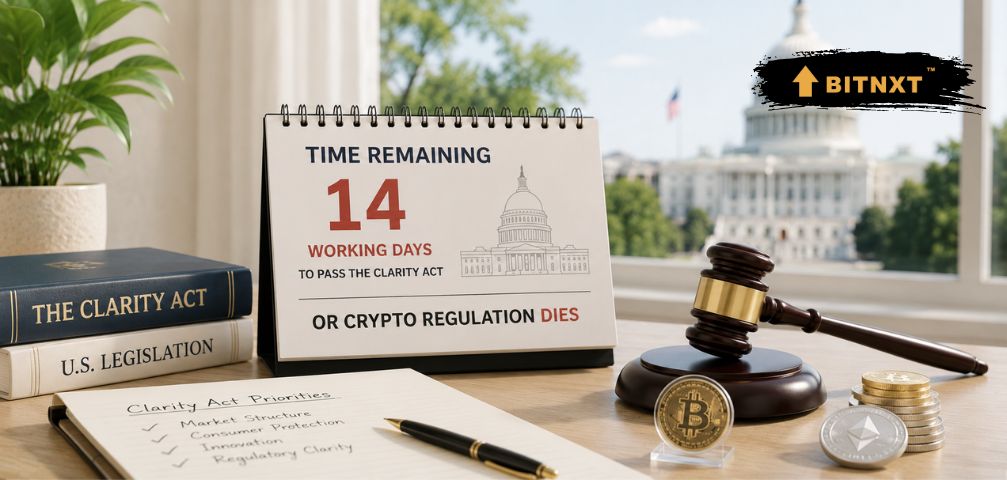
The 14 working days between Sep. 14 and the unofficial start of midterm campaign season represent the narrowest legislative window the crypto industry has faced since the bill was first introduced. After those two weeks, senators running for re-election in November will not cast controversial votes on a bill that divides their donor bases. The Clarity Act either survives its September cloture vote or it joins a long list of financial regulation proposals that arrived with bipartisan goodwill and left with nothing to show for it.


