






























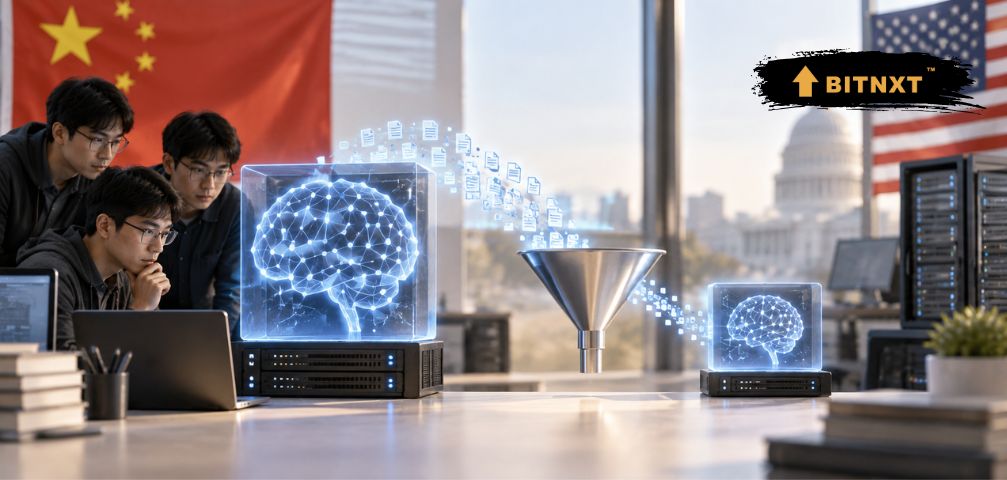
The NSA, FBI, and CISA on Tuesday accused six Chinese AI firms of "malicious knowledge distillation," naming DeepSeek, Alibaba, and Moonshot AI, and the number that should reset the debate is the scale: billions of tokens extracted across millions of API requests from American frontier models since at least late 2024. Targets included Anthropic's Claude, OpenAI's GPT, Google's Gemini, and xAI's Grok. The agencies say it happened with the Chinese government's awareness, using proxy services and account networks to slip past rate limits and geo-fencing, with a heavy focus on copying coding, math, and reasoning capability.
The advisory lands on a market still bruised by the original story. Moonshot's Kimi K3, an open-weight model that beat OpenAI and Anthropic on a leading coding benchmark in July, triggered a genuine panic about the cost advantage of Chinese labs, and CoinDesk's own framing captured the fear: Moonshot "showed that a Chinese lab could release an open-weight model capable of competing with, and on some benchmarks beating, systems from OpenAI and Anthropic without matching the huge spending of the American AI leaders." The new accusation answers the puzzle that July left open, and the answer is the most mundane one available: the cheap training run may not have been cheap, just funded partly by someone else's compute.
What Distillation Allegations Do to the AI Trade
The immediate market damage ran through Chinese tech: Z.ai fell roughly 27%, MiniMax dropped 16%, Asian semiconductor equities weakened across the board, and Korea's Kospi lost another 3.5% in following sessions. Bitcoin and majors sold off alongside risk assets, which is the transmission channel that matters for crypto readers: a national security story about API scraping moved crypto because it repriced the entire AI-complex growth narrative at once. If Chinese model valuations were built on stolen efficiency, the defensive moat around U.S. frontier labs, the ones powering Anthropic's trillion-dollar IPO preparation and the sector's record AI venture funding rounds, is deeper than July's panic priced. If it is not, and Kimi K3's efficiency stands on its own, U.S. spend-per-capability questions come straight back.
Expect the compliance response before the diplomatic one. The obvious fixes, identity verification at API endpoints, rate limits that actually bind, aggressive anomaly detection, are all restrictive moves that raise the cost of legitimate research access too. There is a crypto angle worth naming: proof-of-inference and verifiable compute, the Web3 projects selling cryptographic receipts for model calls, suddenly have a use case that is not marketing. Industrial-scale distillation is an attribution problem, and attribution is what blockchains do.
Read the Claims With Both Eyes
Skepticism checklist, because this story invites being spun. The advisory is an intelligence community document naming firms that cannot respond on equal footing; Moonshot did not respond to requests for comment, and Chinese firms have denied similar allegations before. "Awareness" of the Chinese government is asserted, not evidenced publicly. And distillation claims cut both ways for U.S. labs: every accusation of theft is also a confession that the crown jewels sit behind a metered API, priced by the token, open to anyone with patience and proxies. That is a business-model vulnerability no advisory fixes.
What to watch: whether OpenAI, Anthropic, or Google change API terms or add hard identity requirements this month, and whether the U.S. moves from advisories to export-control-style rules on model weights and inference access. The July panic asked whether China had caught up. Tuesday's answer: allegedly, by borrowing the ladder.


