



























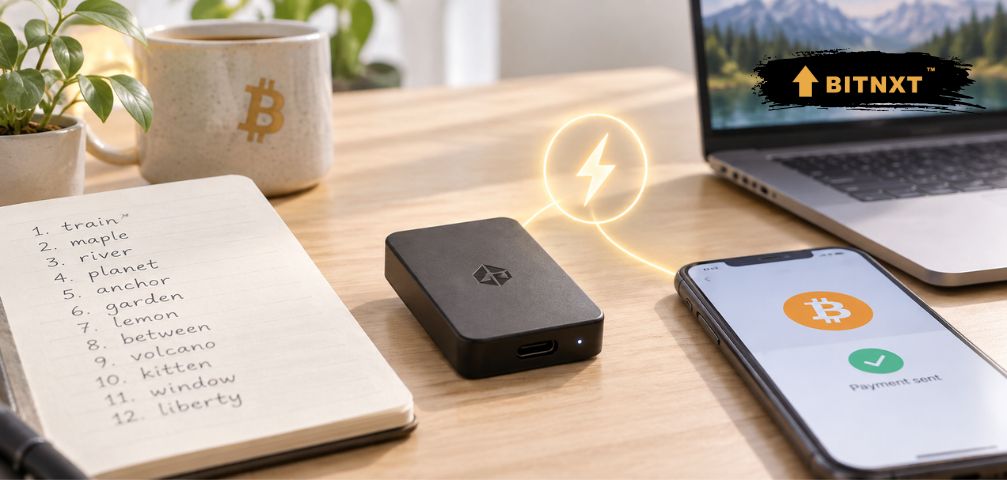
BitBox, the Swiss hardware wallet maker operated by Shift Crypto, has solved the problem that has kept Lightning payments out of most self-custody setups: the second backup phrase. The company's September 2026 Meggen update adds a native, self-custodial Lightning hot wallet inside the BitBoxApp that derives directly from the user's existing hardware wallet seed, meaning customers can send and receive Bitcoin over Lightning without creating or storing any new recovery mnemonic, and a lost phone restores the Lightning wallet from the same hardware backup that already protects the cold wallet. The update supports scanning and paying Lightning invoices, generating invoices, dedicated Lightning payment addresses, and transfers between on-chain BitBox balances and Lightning balances, with cold savings remaining completely segregated from the hot spending funds in the app.
The infrastructure choices are notable: the Lightning wallet runs on Breez SDK, already integrated across more than 100 products, with Lightspark's Spark protocol abstracting node operation, channel management, and liquidity routing away from the user entirely.
Why the BitBox Lightning Wallet Design Matters
The engineering trade-off here is the oldest one in Bitcoin: hot versus cold, and BitBox's answer is compartmentalization rather than compromise. A Lightning wallet must be online to route payments, so it must be hot, and most prior solutions accepted that a Lightning balance means a second key, a second seed, a second thing to lose or fumble during restoration, which is precisely the failure mode that pushes casual users toward custodial wallets like Wallet of Satoshi or Strike, where the Lightning UX is easy because the keys are someone else's. By deriving the hot wallet from the hardware seed, BitBox removes the second phrase while keeping the segregation: the hardware device's savings are untouched by Lightning activity, and the app's guidance tells users to "treat the Lightning balance like cash carried in a physical wallet and keep larger amounts in the hardware wallet." The design mirrors the broader self-custody UX push we have tracked across the industry, from passkey-based web3 identity work to the post-compromise security recalibration that followed the Coldcard breach, where the lesson was that vendor-held data is a liability no hardware wallet should carry.
The Friction the Update Cannot Remove
The honest limit of the announcement is not technical, it is fiscal and trust-based. In the United States, the IRS treats every crypto spend as a property disposition, meaning a Lightning purchase of coffee requires calculating capital gains on cost basis and fair market value at the moment of payment, with no federal de minimis exemption, so the world's fastest payment rail carries the accounting overhead of a securities trade, and no seed-derivation trick fixes that. The tax friction argument matters because it caps the medium-of-exchange use case that Lightning exists for, and it explains why the update's most realistic near-term users are outside the U.S., in the markets where mobile Bitcoin payments already compete with remittance rails. The second caveat is the dependency stack: Breez and Lightspark are third parties, and a Lightning wallet whose channel management and liquidity routing are abstracted is still trusting protocol and SDK providers for the rail's operation, a smaller trust than custody but a real one, and the same abstraction that makes the UX clean concentrates operational dependence. The counter-argument is fair too: this is how Lightning was always going to reach normal people, through companies hiding the node operations entirely, and Coinbase's April 2024 Lightspark integration and Nubank's partnership proved the pattern before BitBox brought it to hardware-wallet users.
What to Watch
Watch whether the pattern spreads to the other hardware makers, a Ledger or Trezor Lightning wallet on the same single-seed architecture would validate the design as the standard; watch whether any U.S. de minimis exemption finally moves in Congress now that payment UX has outrun the tax code; and watch BitBox's restoration statistics, the first wave of users restoring Lightning balances from hardware backups will be the real security test. The second seed phrase has been Lightning's toll booth for years. BitBox just removed it, and the remaining toll is charged in basis points by the IRS.


