


























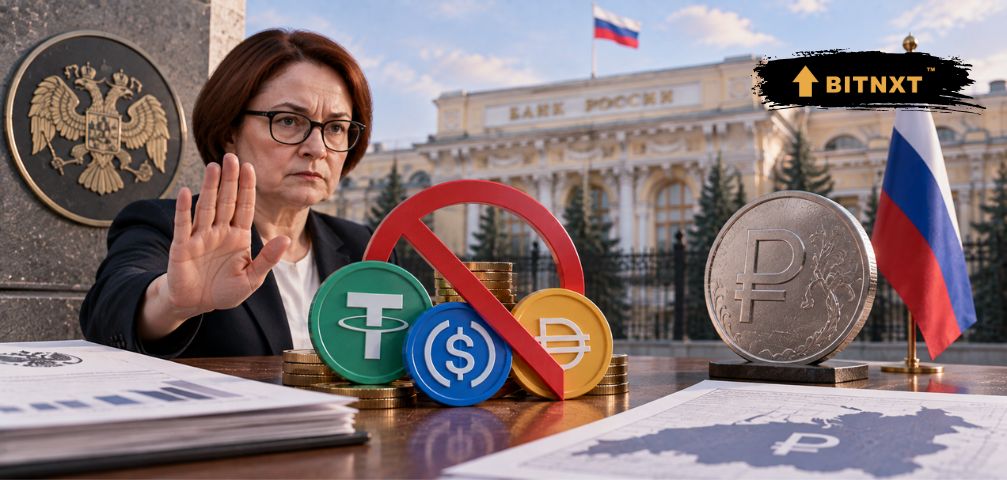
The Bank of Russia has named cryptocurrencies and stablecoins as risks to its own financial system in its strategic review, "Main Directions for the Development of the Financial Market of the Russian Federation for 2027 and the Period of 2028 and 2029," warning that increased use of digital currencies, "particularly stablecoins, could lead households to use privately issued assets in place of the ruble... carrying the possibility of a complete loss of invested funds." The central bank's indictment runs the full list: crypto assets are "money surrogates" that threaten to displace the ruble, carry complete capital-loss risk, lack obligated counterparties or collateral, enable anonymous illicit finance, and circumvent capital controls. The document lands while the country's regulated experiment is barely two weeks old: a legal trading framework launched September 1 under central bank and Rosfinmonitoring oversight, built on the digital asset law President Putin signed on August 4, 2025, permitting Bitcoin, Ether, and Tether as proposed trading assets, with non-qualified retail investors capped at 300,000 rubles, about $3,200, in annual purchases per intermediary after mandatory testing, while qualified investors trade uncapped.
The dual message is the news: Russia will let you buy crypto, legally, through a licensed window it explicitly does not trust, and it will now document that distrust in its own strategy documents.
The Ruble Containment Doctrine
Read the two halves of the policy together and a coherent doctrine appears. Domestic payments in crypto remain strictly illegal; cross-border settlements are permitted, the sanctions-evasion channel we have tracked as Russia's pragmatic face, from the mining crackdown that shut down Moscow-region operations straining the power grid to the long legal shadow over domestic crypto activity epitomized by the charges against Telegram founder Pavel Durov. The strategy document's stablecoin language is the most pointed, because Tether's USDT is one of the three assets the new framework proposes for regulated trading: the central bank is warning households against the very instrument its own licensed venues would sell them, a contradiction resolved only by the cap and testing regime, which functions as a friction tax on exactly the adoption the document fears. The enforcement data explains the paranoia's source: in H1 2026 the central bank blacklisted 2,600 crypto wallets linked to more than 1 billion rubles in illicit flows, identified 929 financial pyramids of which over 74% utilized crypto, and counted 379 illegal investment schemes. Rosfinmonitoring adviser Vlada Gracheva's defense of the new INN (tax identification number) mandate for depository account holders, that it "will improve transparency around cryptocurrency transactions," reads as the collection side of the same machine: transactions above 60,000 rubles now require detailed disclosure.
What the Warning Reveals and Conceals
The analytical honesty cuts in two directions. What the document reveals: the ruble's monopoly inside Russia is now a managed defense rather than an assumption, and the central bank considers crypto substitution a live threat rather than a fringe phenomenon, which is itself a datapoint about how much sanctions-era capital pressure has normalized dollar-like digital assets inside the economy it controls. What it conceals: the state's own dependence on the channel it damns, cross-border crypto settlement remains the sanctioned economy's working bypass, and the document's criminal-liability push for unlicensed operators, plus administrative fines for non-compliant licensed firms, is less about protecting households than about forcing settlement flows through inspectable pipes. The irony with real bite is Tether-specific: a settlement architecture that leans on USDT hands a freeze-capable offshore issuer leverage over state-critical flows, the mirror image of the central bank's own complaint about private assets displacing sovereign money. The 300,000-ruble cap, meanwhile, is calibrated to push activity underground, a $3,200 annual ceiling for a market whose blacklisted wallets moved a billion rubles is a speed bump beside a highway.
What to Watch
Watch whether USDT survives the final approved-asset list, given the strategy document's stablecoin hostility; watch the wallet blacklist's growth rate, which measures the underground market the cap creates; and watch whether the criminal-liability proposal for unlicensed operators becomes Duma law, which would formalize the two-tier system completely. Russia's message to the world is a paradox in a press release: crypto is a threat to the currency, a channel for the treasury, and a business for licensed intermediaries, all at once, with the central bank now writing all three sentences in the same document.


