


























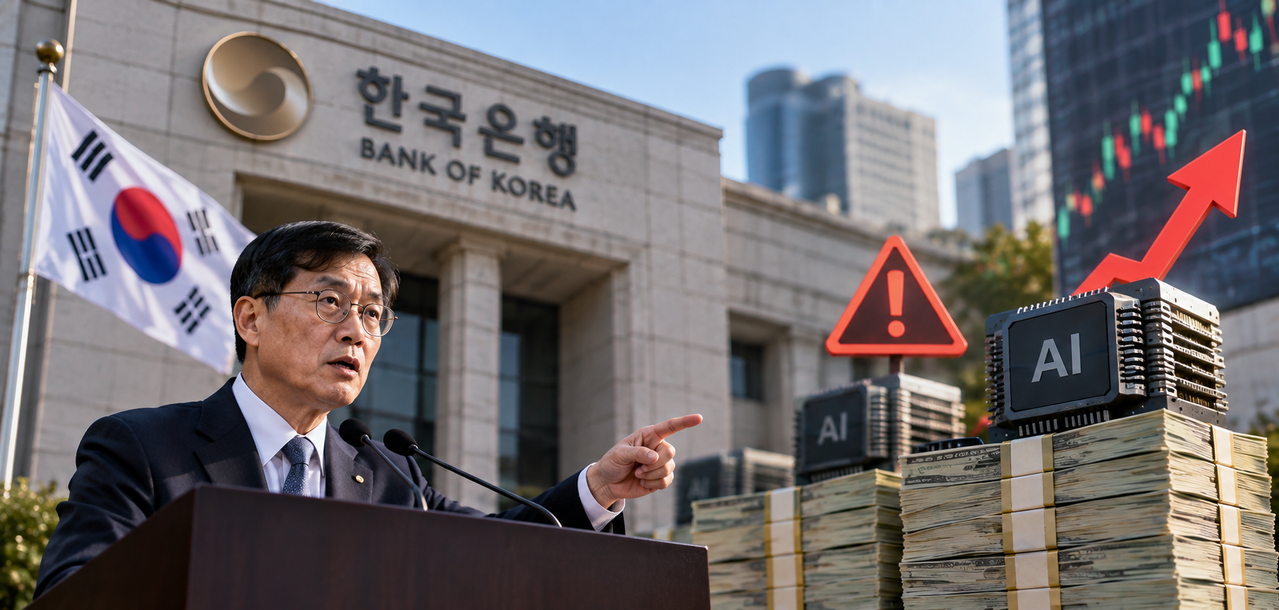
The Bank of Korea has delivered a warning that doubles as a macroeconomic fever chart: the country's market is now so concentrated in two AI chipmakers that their leverage dynamics have become a systemic question. In its September monetary policy report, released September 10 and gaining attention this week, the central bank cautioned that Samsung Electronics and SK Hynix together represent nearly half of the Kospi benchmark's market capitalization, and that Hong Kong-listed leveraged exchange-traded products tied to those two stocks expanded more than twentyfold in the first half of 2026, with leverage of up to 4x, an offshore derivatives complex that can transmit forced daily rebalancing flows straight into Seoul's index. The warning lands in an economy running hot on the same chips: Q2 2026 nominal GDP surged 26.4% year over year on soaring semiconductor export prices, semiconductors accounted for more than 40% of merchandise exports in key months, and the Bank of Korea revised its 2026 real GDP growth forecast up to 2.6% from 2.0%, with inflation at 2.7% and the policy rate at 3.0%.
The gap between those two sentences, a 26.4% nominal boom and a central bank fretting about leverage, is where the real story sits.
What the Bank of Korea Warning Actually Flags
Two distinct risks sit inside the report, and conflating them misreads it. The first is concentration: when two firms are half an index, every Kospi-tracking pension, ETF, and retail portfolio in the country is functionally a semiconductor bet, and the economy's fiscal base, household wealth, and export earnings all key off the same AI cycle. The second is the leverage transmission channel: 4x leveraged Hong Kong ETPs must rebalance daily, which means Hong Kong's flows amplify Seoul's price moves mechanically, in both directions, a feedback loop that turned theoretical in July when SK Hynix fell as much as 14% in the Kospi selloff. The GDP accounting adds its own distortion worth naming plainly: the 26.4% nominal surge and the 21.9% GDP deflator increase reflect terms-of-trade price gains from HBM memory prices, not a 26% expansion in physical output, which is why the central bank simultaneously lifted its real growth forecast by a modest 0.6 points while the nominal figures look like a boom. Policy is already reacting, with regulators proposing in July to cap retail exposure to single-stock leveraged ETFs at 20% of investment assets, and the chipmakers themselves are being pulled at, both rejected KEPCO's demand for 25 trillion won, about $18.7 billion, in advance payments for power infrastructure, a reminder that the AI buildout's constraint is electricity.
Why a Central Bank Warning About Chips Is a Crypto Story
The transmission into crypto runs through the same retail channel that makes Korea the world's most search-hungry investment market. Korean households rotate between semiconductor shares and digital assets as one risk pool, the pattern behind the Kimchi premium and the search-interest surges we have tracked across Korean retail, and the crypto tax fight currently before the National Assembly, developments that accompanied the Digital Asset Framework Act's fall acceleration. If the AI chip cycle cracks, the leverage flush hits Kospi first, but the same risk appetite that bought 4x chip ETPs is the risk appetite that buys altcoins, so a Korean risk-asset deleveraging would hit crypto liquidity within days, not months. The global AI capex backdrop makes this systemic rather than local: the same buildout that has fueled the AGI race's balance sheets is now levered through exchange-traded products and concentrated in two firms whose customers, the AI labs, are themselves borrowing to build, the rally fuel behind AI stocks and crypto alike this year.
What to Watch
Three indicators will test the central bank's worry: whether the 20% leveraged-ETF cap becomes law, whether Hong Kong ETP growth continues at H1's pace through the autumn, and whether HBM pricing, the variable behind the nominal GDP miracle, holds as new capacity arrives. The Bank of Korea's report is not a crash call; growth is "expected to remain robust." It is the rarer thing, a central bank documenting its own market's architecture while the architecture is still standing. Investors should read it the way the bank wrote it: a boom measured in nominal prices, a leverage complex measured in multiples, and a policy rate set against both.


