






























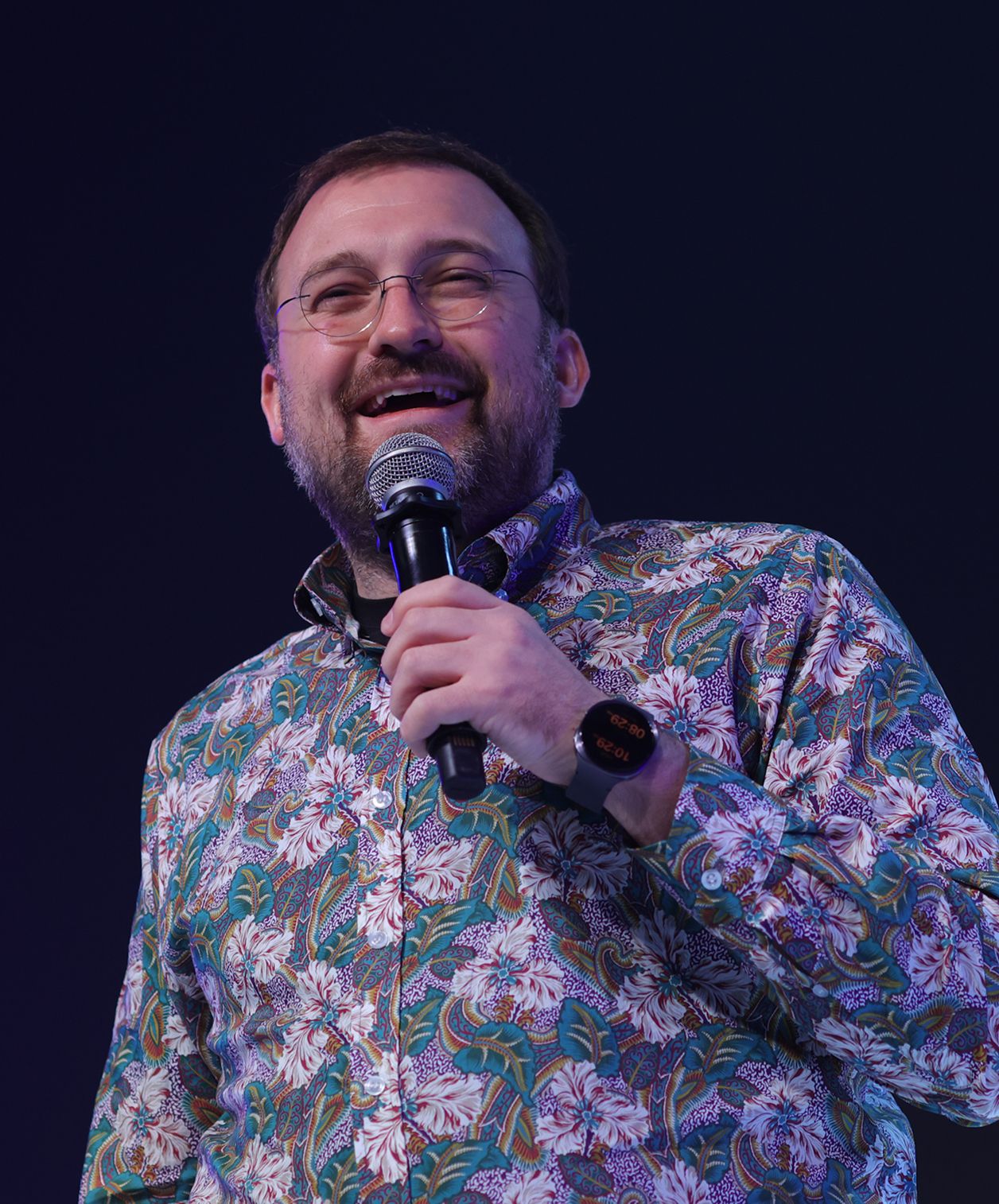
Bio
Charles Hoskinson is an American blockchain entrepreneur best known as the founder of Cardano and Input Output and as one of Ethereum's original co-founders. He joined Ethereum during its formative period in 2013–2014 but later left the project following disagreements over its organizational direction. He founded Input Output in 2015 with Jeremy Wood and subsequently helped develop Cardano through a research-driven approach involving formal methods and peer-reviewed academic work. Cardano's Ouroboros Proof-of-Stake family, ADA, smart contracts, and decentralized governance are central to the project. His major 2026 areas include community-led Cardano governance, Leios, Mithril, Midnight, Bitcoin/Cardano interoperability, and Input Output research.
About Charles Hoskinson
Charles Hoskinson is an American technology entrepreneur and blockchain architect. He is the founder of Cardano, the co-founder and CEO of Input Output, and one of Ethereum's original co-founders. His work has focused on research-driven decentralized infrastructure, Proof-of-Stake systems, and digital governance. He is not the CEO of Cardano — Cardano is a decentralized blockchain network, not a company.
Early Life and Education
Charles Hoskinson was born on November 5, 1987, in Maui, Hawaii, USA. He studied mathematics at university, including at Metropolitan State University of Denver and the University of Colorado Boulder, before leaving to pursue work in cryptocurrency and blockchain technology. He has not claimed to hold a completed academic degree, and public records do not confirm one. His mathematical background has informed his approach to blockchain research, but he should not be described as a professional mathematician or PhD.
Entering Bitcoin
Hoskinson became involved with Bitcoin around 2011–2013. His early interest grew from cryptography, mathematics, and decentralized systems. He participated in early Bitcoin community discussions and began exploring the technology's potential applications.
Bitcoin Education Project
In 2013, Hoskinson was involved in the Bitcoin Education Project, an initiative offering free online Bitcoin education. The project aimed to introduce a broad audience to Bitcoin and cryptocurrency concepts. Historical accounts vary on exact enrollment figures, which should not be presented as verified without primary sourcing.
Co-Founding Ethereum
Hoskinson joined Ethereum during its founding period in late 2013. Ethereum.org recognizes him among Ethereum's eight original co-founders: Vitalik Buterin, Gavin Wood, Joseph Lubin, Jeffrey Wilcke, Mihai Alisie, Anthony Di Iorio, Amir Chetrit, and Charles Hoskinson. His early Ethereum role was associated with organizational structure, business strategy, and discussions about Swiss foundation setup and fundraising. He should not be credited with technical contributions that belong to other Ethereum founders.
Leaving Ethereum
Hoskinson left Ethereum in 2014. Historical accounts describe disagreements over whether Ethereum should become a for-profit company or remain a nonprofit-oriented project. The departure involved complex founder dynamics and should not be reduced to personal drama. His Ethereum association is historical; he does not currently have a role in the Ethereum Foundation.
Founding Input Output
In 2015, Hoskinson founded Input Output with Jeremy Wood, a former Ethereum colleague. The company was originally known as IOHK (Input Output Hong Kong) and later rebranded to Input Output Global (IOG) and now operates as Input Output. Input Output is a blockchain infrastructure and research engineering organization. Current official material states it was founded in 2015 by Charles Hoskinson and Jeremy Wood. Hoskinson serves as CEO, and Wood serves as Chief Strategy Officer. Input Output is distinct from Cardano — it is a company that develops and researches blockchain technology, including but not limited to Cardano.
Founding Cardano
Cardano development began in 2015 through Input Output, with support from the broader founding ecosystem including the Cardano Foundation and EMURGO. Hoskinson is recognized as the founder of Cardano. Cardano is an open-source decentralized blockchain network, not a product owned by Input Output. The Cardano mainnet launched in September 2017 with the Byron era.
Cardano Founding Organizations
Three organizations were involved in Cardano's founding ecosystem: Input Output (the engineering and research company), the Cardano Foundation (an independent Swiss-based organization supporting the Cardano ecosystem), and EMURGO (a commercial adoption arm). These are separate entities, not subsidiaries of one another. Hoskinson is not the CEO or chairman of the Cardano Foundation or EMURGO.
What Is Cardano?
Cardano is a decentralized Proof-of-Stake blockchain platform developed through research-driven and evidence-based methods. Current use cases include transactions, smart contracts, DeFi, digital identity, governance, tokenization, and payments. Cardano is an open-source network that no single entity owns or controls.
ADA
ADA is Cardano's native cryptocurrency. It functions as transaction fuel, a staking deposit for validators, a means of network participation, and a governance instrument. ADA is not Charles Hoskinson's personal coin, and he does not personally control its supply. The name ADA honors Ada Lovelace, the 19th-century mathematician recognized as the first computer programmer. The Cardano network is named after Gerolamo Cardano, the Renaissance mathematician.
Ouroboros
Ouroboros is Cardano's Proof-of-Stake consensus protocol family. It was developed by an academic and research team, not by Hoskinson alone. The protocol has its origins in peer-reviewed academic papers and has evolved through multiple iterations. Hoskinson should not be credited with inventing Ouroboros — it is the product of a research team including cryptographers and academics associated with Input Output and partner institutions.
Proof of Stake on Cardano
In Cardano's Proof-of-Stake system, ADA holders stake or delegate their ADA to stake pools. The protocol selects participants for block production according to consensus rules. Cardano did not invent Proof of Stake as a general concept, but Ouroboros was one of the first academically peer-reviewed Proof-of-Stake protocols.
Research-Driven Development
Input Output's approach to Cardano emphasizes academic research, formal methods, and peer review. However, peer-reviewed research does not mean every Cardano software component is itself academically peer-reviewed. The research-driven approach has been both praised for rigor and criticized for slower development compared to some other blockchain projects.
Cardano Development Eras
Cardano's development has been organized into eras named after historical figures: Byron (initial mainnet), Shelley (decentralization and staking), Goguen (smart contracts), Basho (scaling and interoperability), and Voltaire (governance). These era labels were the historical roadmap framing. Current 2026 Cardano development continues beyond these labels, with specific technical upgrades and governance milestones now driving the roadmap.
Byron
The Byron era began with Cardano's mainnet launch in September 2017. This was the initial operational phase of the network, with federated block production and basic transaction functionality.
Shelley
The Shelley era, activated in July 2020, marked Cardano's transition to decentralized block production. Stake pools and staking became operational, reducing the network's dependence on Input Output for block production.
Goguen
The Goguen era introduced smart-contract functionality to Cardano. The Alonzo hard fork in September 2021 enabled Plutus smart contracts, allowing developers to build decentralized applications on Cardano.
Basho
The Basho era focused on scaling and interoperability. Work during this period included sidechains, Hydra, and other scaling technologies.
Voltaire and Decentralized Governance
The Voltaire era focuses on on-chain governance, a community treasury, and constitutional governance. Cardano has transitioned toward a governance model where ADA holders, delegated representatives (DReps), a Constitutional Committee, and stake pool operators participate in protocol decisions.
Chang Hard Fork
The Chang hard fork, activated in September 2024, introduced Cardano's on-chain governance system. It established the roles of DReps, the Constitutional Committee, and governance actions, enabling stakeholders to vote on protocol changes.
Plomin Hard Fork
The Plomin hard fork, activated in 2025, further refined Cardano's governance capabilities, building on the Chang upgrade to expand community-led decision-making.
Van Rossem Hard Fork
On July 18, 2026, Cardano activated the Van Rossem hard fork, moving the network to protocol version 11. This was the first Cardano upgrade in history to be proposed, debated, and ratified entirely through its on-chain governance system, rather than by Input Output. The upgrade lowered smart contract execution costs and laid groundwork for the planned Ouroboros Leios scaling upgrade. DReps voted approximately 79% in favor, the Constitutional Committee found it compliant, and stake pool operators approved it by a narrower margin. This marked a significant shift in who controls Cardano protocol changes.
Who Controls Cardano?
Charles Hoskinson is an influential founder, but he does not control Cardano. Input Output is a developer and research contributor. The Cardano community participates in governance through DReps, the Constitutional Committee, and stake pool operators. After the Chang, Plomin, and Van Rossem upgrades, Cardano's governance is increasingly community-led. Hoskinson's influence is historical and public, not protocol-level control.
Intersect
Intersect is a member-based organization involved in Cardano governance and open-source ecosystem coordination. It is not Hoskinson's personal organization. Intersect helps coordinate community participation in Cardano's governance and development processes.
Project Catalyst
Project Catalyst is Cardano's treasury and community innovation funding system. Community members propose projects, and ADA holders vote to allocate funding. Hoskinson does not personally choose grant recipients.
Smart Contracts and the eUTXO Model
Cardano uses an Extended UTXO (eUTXO) model, which differs from Ethereum's account-based model. In the eUTXO model, transactions consume and produce unspent outputs, enabling more predictable fee calculation and parallel processing. The eUTXO model has different trade-offs compared to the account model; neither is universally superior.
Plutus
Plutus is Cardano's smart-contract programming language, based on Haskell. It was developed by the Input Output engineering team. Hoskinson is not the sole creator of Plutus.
Hydra
Hydra is a Cardano scaling technology that uses off-chain, head-based techniques to increase throughput. As of 2026, Hydra continues to be developed and deployed. Theoretical throughput figures should not be presented as real network throughput without qualification.
Mithril
Mithril is a Cardano technology that enables stake-based signatures for lightweight verification and faster synchronization. As of mid-2026, Mithril development includes active SNARK circuit work to improve verification efficiency. Mithril supports the broader goal of lightweight Cardano verification.
Leios
Leios is a major Cardano throughput upgrade designed to increase network capacity through Input Endorsers and a new block-diffusion architecture. As of Q2 2026, a public SPO testnet for Leios went live. The testnet is named the Musashi Dojo. The Dijkstra-era roadmap targets Linear Leios in Phase 1 around Q4 2026, with a subsequent Peras upgrade planned for 2027. Leios is not yet deployed on mainnet and should not be presented as fully operational.
Dijkstra Era
Current Cardano material references the Dijkstra era in connection with Leios and upcoming development. The Dijkstra roadmap targets Leios in 2026 and Ouroboros Peras in 2027. This represents the current phase of Cardano's scaling and throughput evolution.
Bitcoin DeFi and CANS
A major 2026 area for Input Output and Cardano is Bitcoin interoperability. In July 2026, Input Output introduced the CANS protocol (Cyclic Atomic N-party Swap). CANS enables trustless cross-chain exchanges between blockchains without bridges, wrapped tokens, or custodians. Participants arrange in a ring where each sends assets once and receives once, with the entire swap enforced as atomic — either everyone gets what they agreed to, or nobody loses anything. The protocol works across blockchains with native Schnorr signature support, including Bitcoin and Cardano. CANS is designed to make Bitcoin's liquidity usable within Cardano's DeFi ecosystem. The reference implementation is being developed on GitHub. In March 2026, FluidTokens announced the first atomic swap between Cardano and Bitcoin on mainnet.
Midnight
Midnight is a privacy-focused blockchain network developed by Input Output and stewarded by the Midnight Foundation. It is positioned as a Cardano partner chain. Midnight's mainnet is live as of 2026. The network uses a dual-token model: NIGHT is the unshielded utility and governance token, while DUST is the shielded, non-transferable resource used to pay for transactions and smart contract execution. Midnight focuses on programmable privacy and selective disclosure, enabling institutions and developers to choose what remains private and what is revealed. NIGHT tokens have been minted and are live on Cardano mainnet. Hoskinson's exact founder relationship to Midnight should be described as Input Output-backed rather than personally founded unless primary sources use that terminology.
Privacy and Selective Disclosure
Hoskinson and Input Output have emphasized privacy-preserving smart contracts, identity, data protection, and regulatory-compatible disclosure. Midnight's rational privacy model enables selective disclosure, allowing compliance without full transparency. This work connects to broader themes of zero-knowledge technologies and identity.
RealFi and Africa
Hoskinson and Input Output have pursued blockchain initiatives in Africa, including a digital identity project in Ethiopia. The current status of these initiatives should be verified against primary sources rather than relying on old partnership announcements. Some projects have evolved or been restructured since initial announcements.
Atala PRISM and Identus
Atala PRISM was an Input Output identity product. It has evolved into Hyperledger Identus, an open-source decentralized identity framework. Current branding should reflect this evolution rather than presenting discontinued branding as active.
Input Output Research
Input Output conducts research across consensus, cryptography, zero-knowledge systems, distributed systems, governance, and scalability. Academic papers are published by the IOG research team. Hoskinson should not be credited as an author of academic papers unless he is listed as one.
Cardano Foundation
The Cardano Foundation is an independent Swiss-based organization that supports the Cardano ecosystem. Hoskinson is not the CEO, chairman, or director of the Cardano Foundation. It operates independently of Input Output.
EMURGO
EMURGO is a separate Cardano founding ecosystem entity focused on commercial adoption. Hoskinson is not the CEO or founder of EMURGO. It operates independently of Input Output.
Current Input Output Leadership
As of August 2026, Charles Hoskinson serves as CEO of Input Output. Jeremy Wood serves as Chief Strategy Officer. Input Output continues to lead Cardano research and development, alongside the broader community and governance participants.
What Is Charles Hoskinson Working on Now?
As of August 2026, Hoskinson's active areas include Input Output leadership, Cardano research and development, Leios, Mithril, Cardano governance, Bitcoin interoperability through CANS, Midnight, blockchain policy, and research commercialization. He frequently publishes AMAs, videos, and social posts on Cardano, Bitcoin, Ethereum, crypto regulation, governance, AI, and blockchain adoption. His opinions should be attributed as his views, not presented as facts or as Cardano community consensus.
Public Commentary and Policy
Hoskinson frequently comments on public policy, including stablecoin legislation, market structure, SEC and CFTC matters, and digital asset policy. These are his personal views and should not be presented as government policy or Cardano community consensus. No political affiliation should be assigned unless explicitly verified.
Controversies
Hoskinson has been the subject of public discussions regarding his Ethereum departure, education credentials, Cardano roadmap timelines, and governance disagreements. These should be presented with neutral sourcing. The profile uses the highest-confidence verified education wording and does not editorialize on credential disputes.
Decentralization
Cardano's current governance increasingly reduces dependence on its founding organizations. After the Chang, Plomin, and Van Rossem upgrades, Cardano's governance is community-led, with DReps, the Constitutional Committee, and stake pool operators participating in protocol decisions. Hoskinson's founder influence is high historically and publicly, but protocol control is distributed through the network and governance structures.
No Net Worth or ADA Holdings
Bitnxt does not publish a speculative net-worth figure or personal ADA holdings for Hoskinson. ADA holdings and wallet balances should not be used to calculate personal wealth.
What Hoskinson Did Not Invent
Hoskinson did not invent the blockchain, Bitcoin, Ethereum by himself, Proof of Stake, Ouroboros by himself, smart contracts, zero-knowledge proofs, DeFi, NFTs, or ADA as a unilateral issuer. His major achievement was co-founding Ethereum, founding Input Output, and founding Cardano with its research-driven approach to blockchain development.
Why Charles Hoskinson Matters
Hoskinson is unusual in crypto history because he was involved in the founding period of Ethereum and later built Input Output and Cardano. His contribution centers on pushing a research-oriented model for blockchain design involving cryptography, formal methods, Proof-of-Stake, governance, and long-term protocol engineering. His work has increasingly expanded into privacy, interoperability, Bitcoin-linked DeFi, and decentralized governance. Cardano and Input Output represent one of the most research-intensive approaches in the blockchain industry.
Profile at a glance
- Country
- USA
- Status
- Active


